Itineraries and trekking
Notre-Dame des Fontaines Trail (Roya Valley)
June 1, 2026
- Where does the trail to Notre Dame des Fontaines start, and how do you get to La Brigue?
- Practical information about the Notre-Dame des Fontaines Interpretive Trail
- Route length, elevation gain, and difficulty
- When to hike the trail and what to bring
- An open-air eco-museum nestled among water, forests, and Brigasca culture
- The Seven Springs and the Connection Between La Brigue and Water
- The Four à Chaux and the History of Lime in the Roya Valley
- The Levenza River and the animals of the stream
- The Brigasca Sheep and the Pastoral Culture of the Tèra Brigasca
- The final stretch through the woods before Notre Dame des Fontaines
- Notre Dame des Fontaines, the Sistine Chapel of the Maritime Alps
- Why is Notre Dame des Fontaines so famous?
- The frescoes by Giovanni Canavesio and the Passion cycle
- The Last Judgment at Notre Dame des Fontaines
- The Seven Springs and the Legend of the Shrine
- Visiting hours and ticket prices for Notre Dame des Fontaines
- The return to La Brigue through pastures, streams, and panoramic views of the Roya Valley
Just a few kilometers from La Brigue lies a trail that manages to combine nature, history, and art in a way that is quite rare to find elsewhere. The trail to Notre Dame des Fontaines—officially known as the Sentier d’interprétation de Notre-Dame des Fontaines—is not merely a simple walk through the woods, but a sort of open-air eco-museum that crosses streams, ancient bridges, old lime kilns, and remnants of the pastoral culture of the Tèra Brigasca.
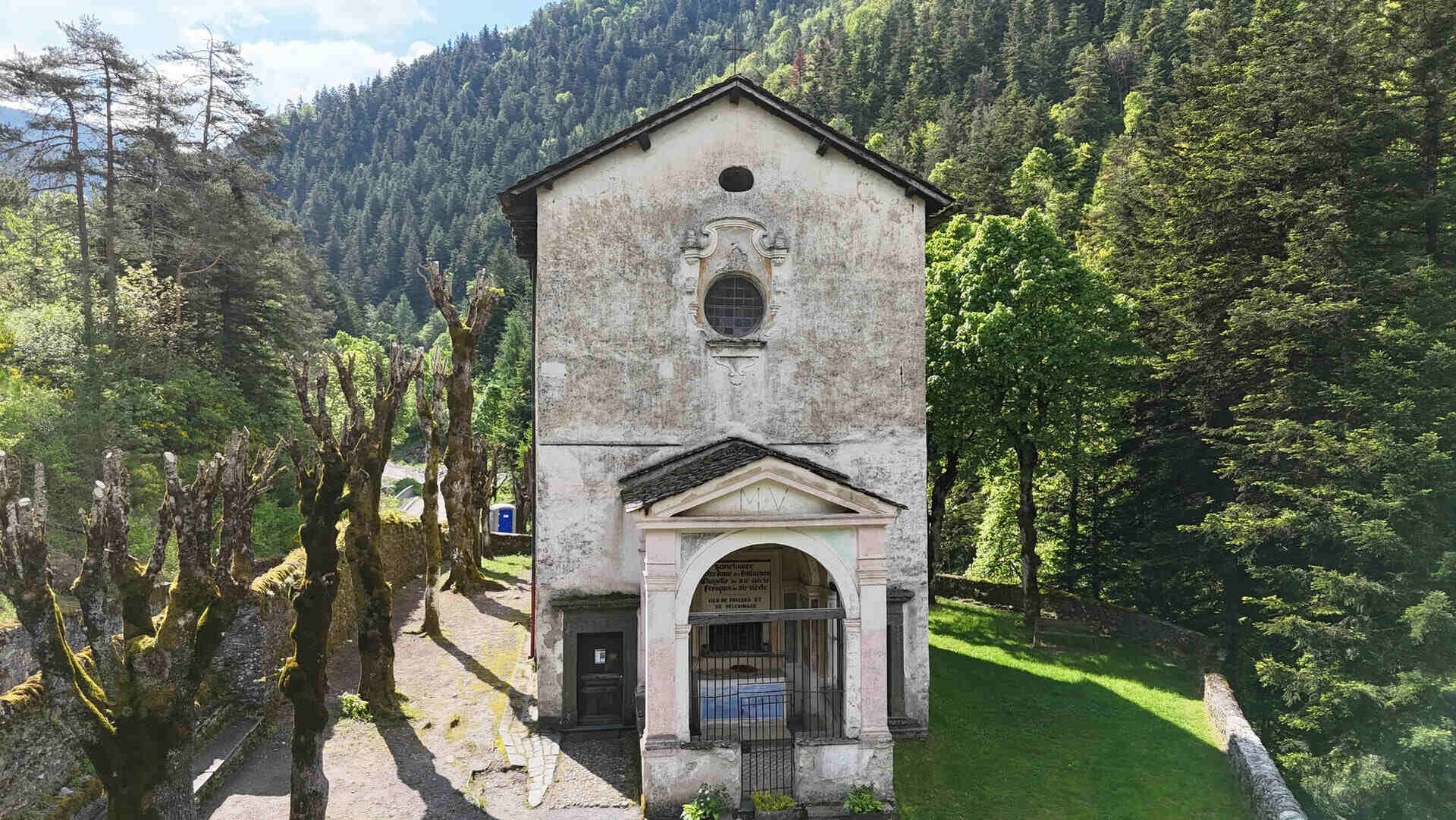
The route begins in the village of La Brigue, in the Roya Valley, and leads to the famous sanctuary of Notre Dame des Fontaines, known as the “Sistine Chapel of the Maritime Alps” for its extraordinary 15th-century frescoes by Giovanni Canavesio and Giovanni Baleison.
The most interesting thing, however, is that the trail doesn’t seem to have been built solely to reach the church. Along the way, you’ll constantly come across informational signs dedicated to the geology of the Maritime Alps, the wildlife of the Levenza River, traditional farming and herding practices, and the relationship that has bound the inhabitants of Briga to the water and the mountains for centuries.
We walked the entire loop trail starting from the center of La Brigue: about 8.5 km through woods, with some scenic stretches and a slightly more challenging central section, but overall accessible to anyone used to walking a bit. And, above all, with a final reward we hardly expected given the simple, almost unremarkable exterior of the sanctuary.
Notre Dame des Fontaines
Where does the trail to Notre Dame des Fontaines start, and how do you get to La Brigue?[ back to menu ]
The trail to Notre Dame des Fontaines is located in the Roya Valley, in the French Alpes-Maritimes, and starts right in the village of La Brigue. The trailhead is near the parking lot on Avenue de Provence, just outside the historic center, where you can join the Sentier d’interprétation de Notre-Dame des Fontaines.
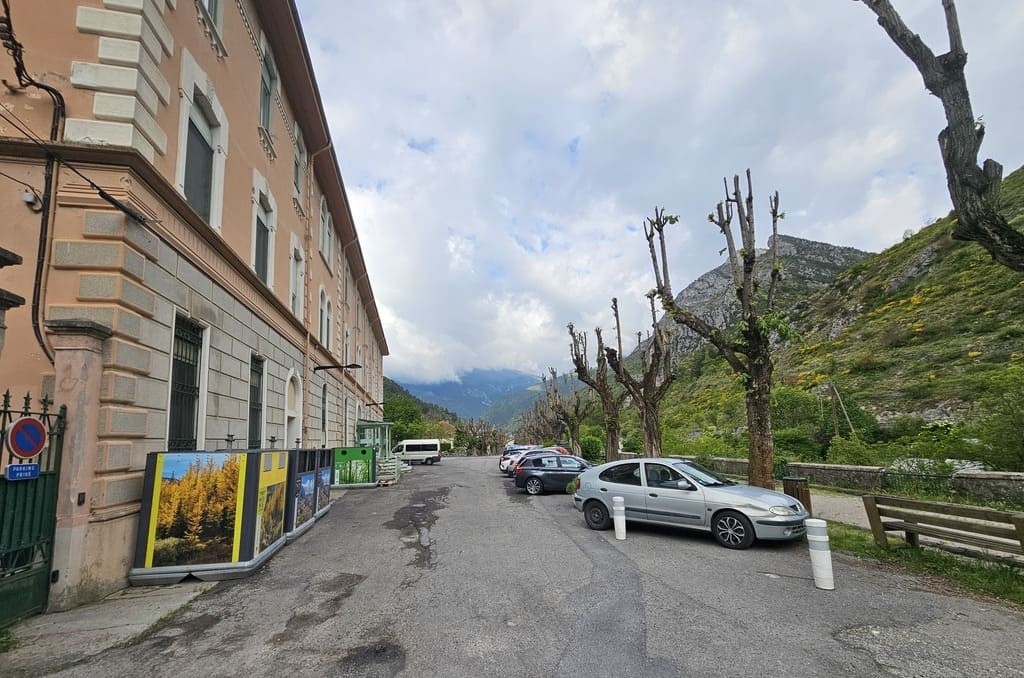
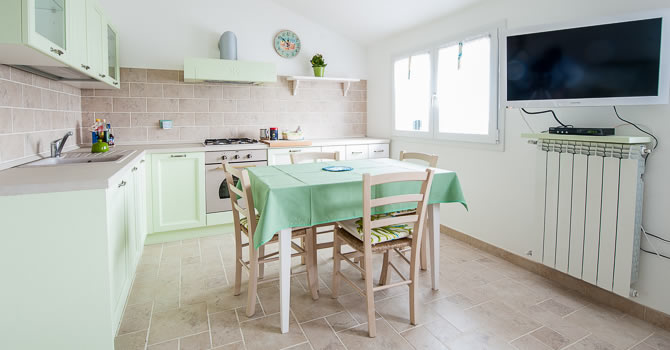
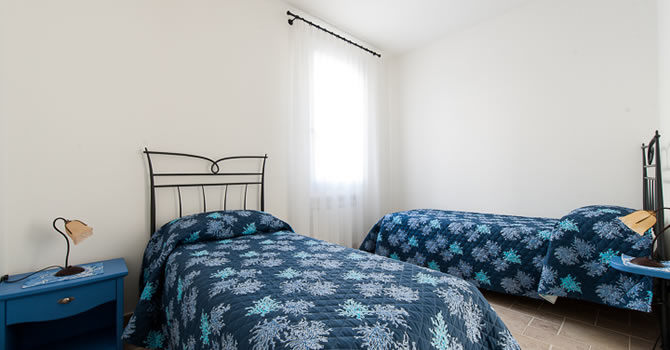
La Brigue is about 100 km from our farmhouse in Diano Marina and can be reached in about two hours by passing through Ventimiglia and traveling up the entire Roya Valley. It is a very scenic route, with ever-changing scenery featuring streams, small mountain villages, and narrow valleys nestled between Italian and French culture.
In recent years, we have visited several towns in this valley, such as Saorge and its monastery, Breglio and the Torre Cruella, as well as the village of La Brigue, but the trail to Notre Dame des Fontaines is probably one of the most well-rounded experiences in the area because it combines hiking, art, and local history into a single itinerary.
For those coming from Piedmont, La Brigue can also be an interesting stop on the way back via the Colle di Tenda Pass. In this case, it’s always a good idea to check for updates on the tunnel and the official schedules on the Colle di Tenda Tunnel website.
Practical information about the Notre-Dame des Fontaines Interpretive Trail[ back to menu ]
The Notre-Dame des Fontaines Interpretive Trail is a loop trail that starts in the center of La Brigue and leads to the sanctuary, passing through forests, streams, ancient bridges, and some of the most interesting areas of the Roya Valley from a natural and historical perspective.
The hike to Notre Dame des Fontaines does not present any particular technical difficulties, but there are some sections in the woods with a fairly steady incline that are best tackled with proper hiking shoes and some experience walking. The trail markers are clearly visible, especially in the first part of the route, and along the entire trail there are numerous informational panels dedicated to the wildlife, geology, and culture of the Tèra Brigasca.
The beautiful church of Notre Dame des Fontaines
Route length, elevation gain, and difficulty[ back to menu ]
The trail to Notre Dame des Fontaines is approximately 8.5 km long in total, forming a loop, with a total elevation gain and loss of about 694 meters.
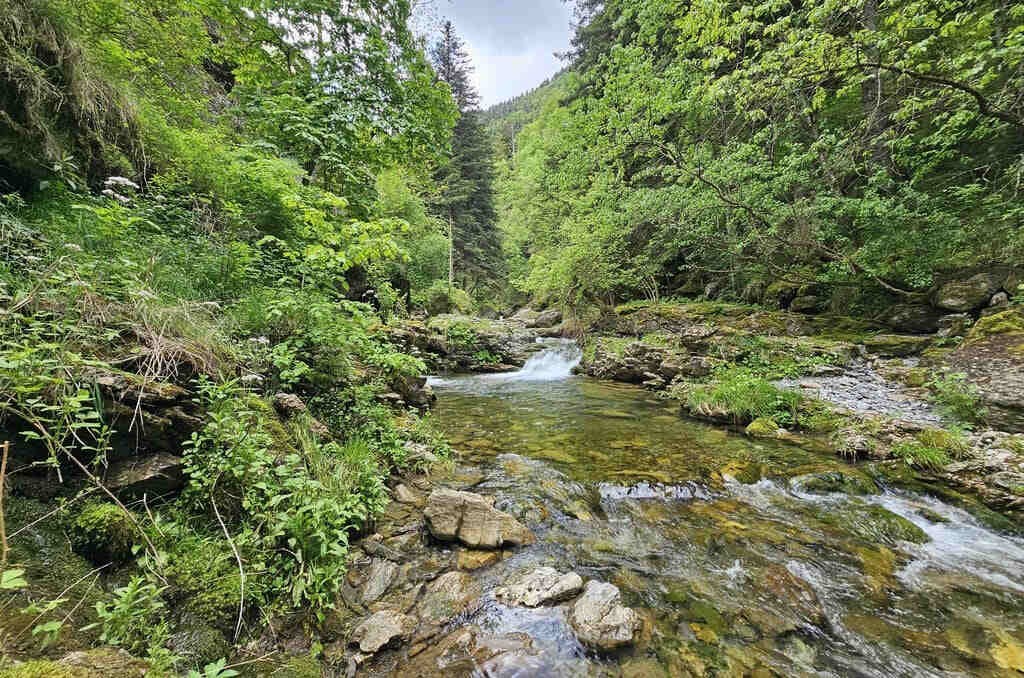
The first part of the interpretive trail is fairly easy and mostly flat: you’ll pass through pleasant wooded areas, cross small bridges, and walk along the Levenza stream until you reach the Four à Chaux, the valley’s old lime kiln.
The most challenging part comes next, with a climb of about 140 meters concentrated over just over 1 km, entirely through the woods. It’s not a particularly difficult stretch, but in some places the climb is quite noticeable. Once you’ve passed this section, the trail becomes easier and gradually descends toward Notre Dame des Fontaines, offering wide-open views of the valley.
Overall, the Notre Dame des Fontaines hike is suitable for those who walk at least a little regularly and are looking for a hike that’s a bit different from the usual—more cultural and less “athletic” than other trails in the Maritime Alps.
When to hike the trail and what to bring[ back to menu ]
In our opinion, the best time to hike the Notre Dame des Fontaines trail is between late spring and summer, when the woods offer more shade and the valley is lush and green. During the colder months, however, some sections can become wetter and less pleasant to walk through.
Hiking boots are recommended, especially for the central section through the woods, where the ground can be uneven and strewn with rocks or roots. No special equipment is required, but it’s a good idea to bring plenty of water, especially on hot days, since there are no places to buy refreshments along the route.
Another useful thing to know is that this hike in the Roya Valley isn’t just about reaching the sanctuary: much of the experience lies in the journey itself, in the informational signs dotted along the trail, and in the constant interplay between nature, local history, and glimpses of Brigasca culture.
Chemin de Saint Jean, La Brigue
An open-air eco-museum nestled among water, forests, and Brigasca culture[ back to menu ]
The most interesting thing about the Sentier d’interprétation de Notre-Dame des Fontaines is that it doesn’t feel like a simple hike designed to reach a scenic overlook or a church. Instead, throughout the entire route, you get the sense that you’re walking through a small open-air eco-museum dedicated to the history of the Roya Valley and the relationship between people, mountains, and water.
Information signs are everywhere, and unlike what often happens on many nature trails, the ones here are actually quite interesting to read. They describe the geological formation of the Maritime Alps, the management of the springs, the local wildlife, the pastoral life of the Tèra Brigasca, and the artisanal activities that for centuries have allowed the inhabitants to make a living in these Alpine border valleys.
The first part of the trail mainly winds through woods and along streams, featuring several small bridges nestled in the greenery and heavily shaded sections. Further on, the landscape gradually changes: the valley opens up, revealing old terraces, ancient lime kilns, and remnants of the farming and herding activities that have characterized this area for centuries.
The Seven Springs and the Connection Between La Brigue and Water[ back to menu ]
Water is probably the central theme of the entire trail leading to Notre Dame des Fontaines. The sanctuary itself owes its name to the seven springs that flow right beneath the building and have been regarded as almost miraculous since ancient times.
According to local tradition, after an earthquake, the springs that fed La Brigue suddenly dried up, causing serious problems for the valley’s agriculture. The inhabitants then made a vow to the Virgin Mary: if the water returned, they would build a grand sanctuary in her honor. Shortly thereafter, the springs began to flow again, and thus Notre Dame des Fontaines was founded.
Along the route, the relationship between the local people and water is a recurring theme. The information panels explain how the inhabitants of Brig have, over time, channeled the waters of the Levenza to power mills, irrigate fields, and support the valley’s artisanal activities.
Once again today, the stream runs alongside most of the trail, alternating between narrow, shady stretches and more open sections, with large, light-colored boulders smoothed by the water and beautiful views of the vegetation in the Roya Valley.
The Four à Chaux and the History of Lime in the Roya Valley[ back to menu ]
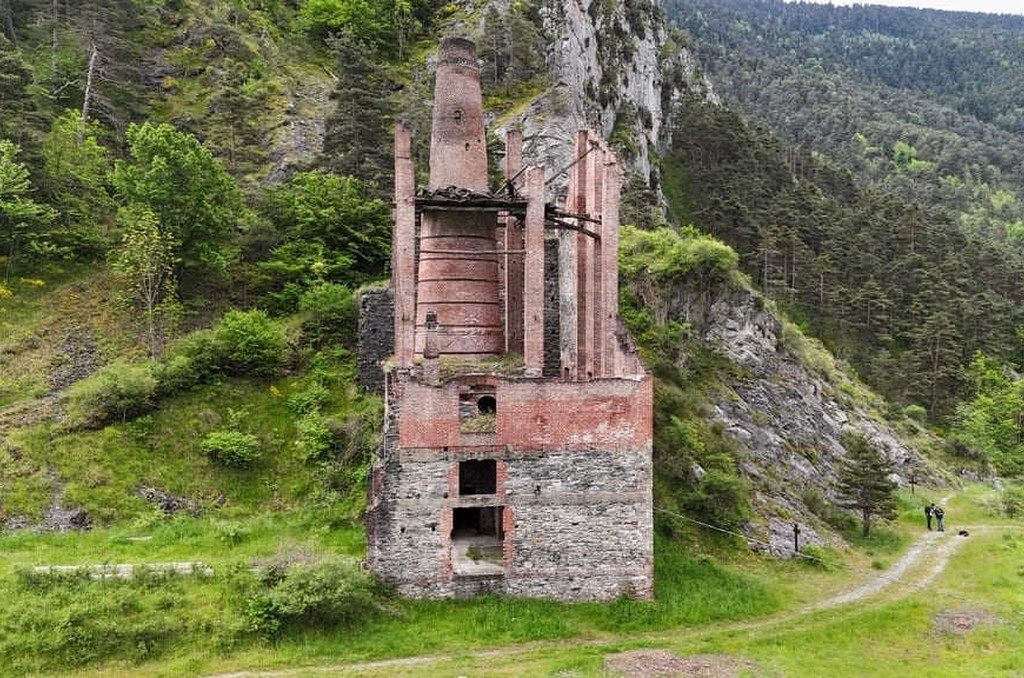
One of the most interesting stops along the trail is the Four à Chaux, the old lime kiln located just outside La Brigue. Here, the hike takes on a completely different atmosphere and becomes almost a journey through mountain industrial archaeology.
The kiln was used to produce the lime needed to build the village’s stone houses, as well as for plastering and restoring historic buildings in the area. The structure is still clearly recognizable: a large circular stone building nestled against the hillside, built in a strategic location near the stream and the wooded areas where the wood used to fuel the fire was sourced.
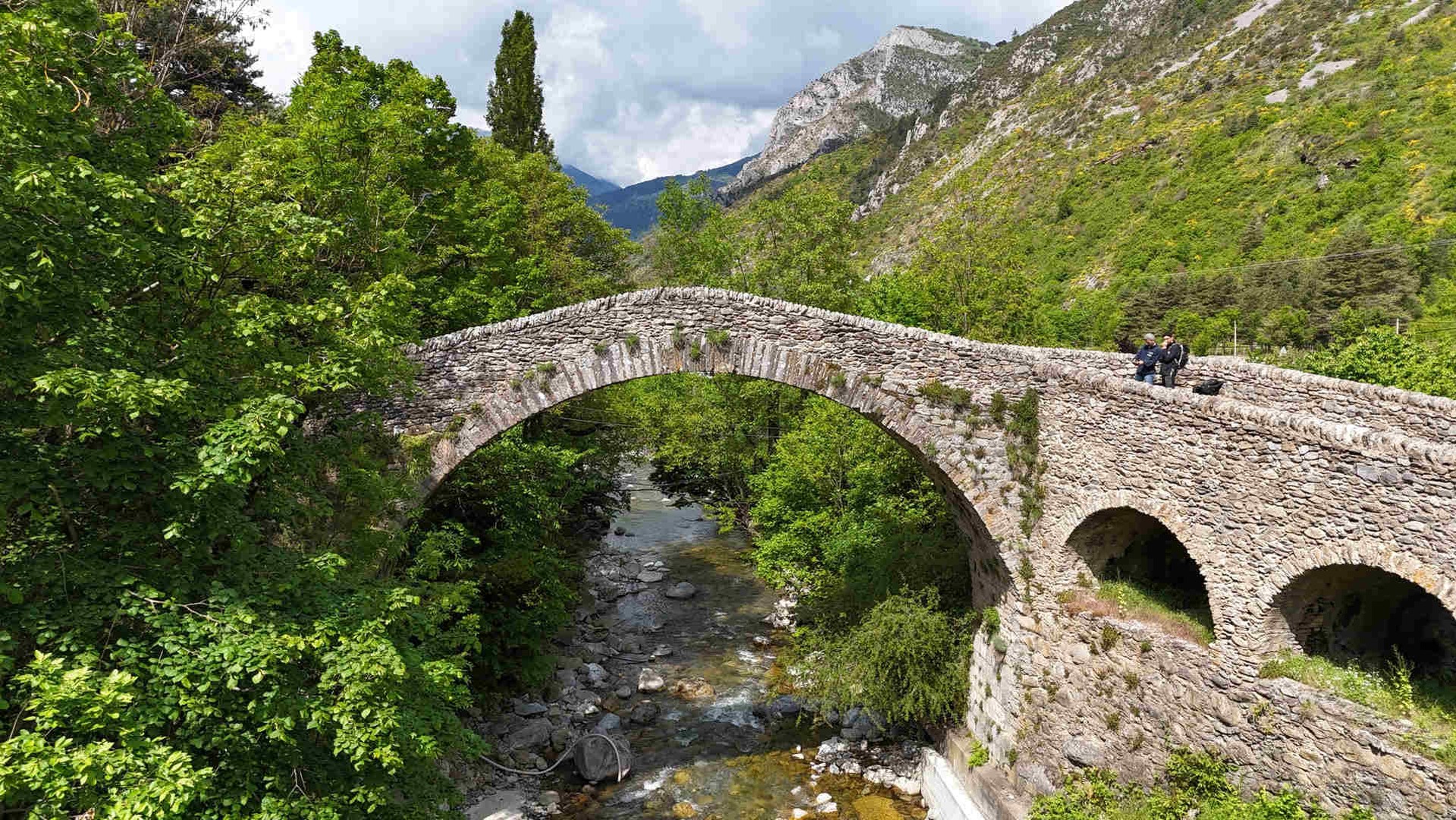
Next to the kiln stands the Pont du Four à Chaux, also known as the Pont Saint-Bernard, a magnificent medieval humpback bridge dating back to the 15th century. For centuries, it served as a key crossing point along the Salt Road, which connected Nice, the Roya Valley, and Piedmont via the Colle di Tenda.
This is one of the most beautiful spots along the route: the bridge, the stream, the forest, and the old oven vividly illustrate just how far from isolated these Alpine valleys were, as they were traversed by merchants, travelers, and skilled workers from all over the region spanning Liguria, Piedmont, and the French Riviera.
The Levenza River and the animals of the stream[ back to menu ]
Along the Interpretive Trail, there are several information panels dedicated to the wildlife of the Levenza, the stream that flows through La Brigue and runs alongside much of the route to Notre Dame des Fontaines.
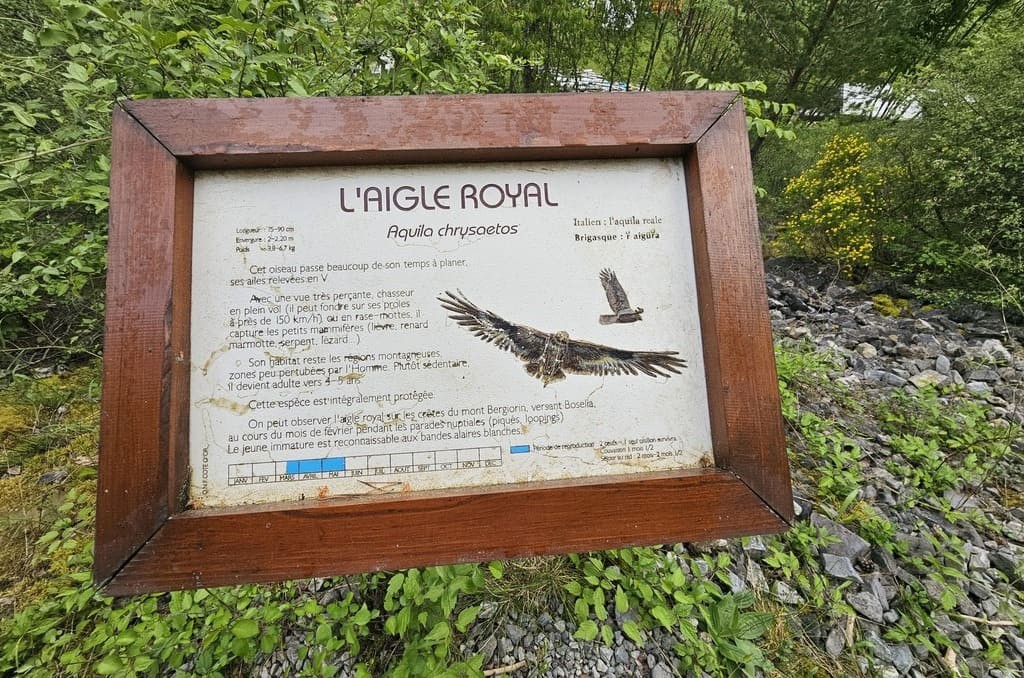
The most interesting sign describes all the biodiversity found around the water: gray herons, kingfishers, yellow wagtails, brown trout, and dippers—small birds that can even walk along the stream bed in search of food.
The Levenza River is also home to the viperine grass snake, a completely harmless snake despite its name and appearance, which resemble those of a viper; meanwhile, the presence of caddisfly larvae is considered a sign of very clean, oxygen-rich water.
Higher up, on the ridges of Mount Bergiorin, you can spot the golden eagle, one of the iconic animals of the Maritime Alps. The information panels also explain the mating season, when these birds of prey perform spectacular dives and circling flights over the valley.
It is precisely this constant interplay between hiking, the landscape, and nature facts that makes this trail so different from many other more “traditional” Alpine hikes.
The Brigasca Sheep and the Pastoral Culture of the Tèra Brigasca[ back to menu ]
Another very interesting part of the tour is the section dedicated to the pastoral culture of the Tèra Brigasca, the Alpine border region historically shared by Liguria, Piedmont, and France.
The panels depict the agro-pastoral life of these mountains and the central role of the Brigasca sheep, a native breed used for the production of milk, wool, and the traditional local toma cheese. Tens of thousands of these sheep were once raised in the area, but today only a few flocks remain, and the breed is considered at risk.
Along the trail, you’ll also come across remnants of the valley’s ancient rural activities, such as ciabot—small stone structures used by shepherds during the summer grazing season—or ca d’arbinée, dry-stone enclosures where beehives were placed to protect the bees from the wind and predators.
The Brigasque language also appears frequently on the trail’s informational signs. Even today, this Alpine dialect is recognized as a minority language within the Occitan language family by the regions of Liguria and Piedmont, further evidence of the unique identity of these border valleys.
The final stretch through the woods before Notre Dame des Fontaines[ back to menu ]
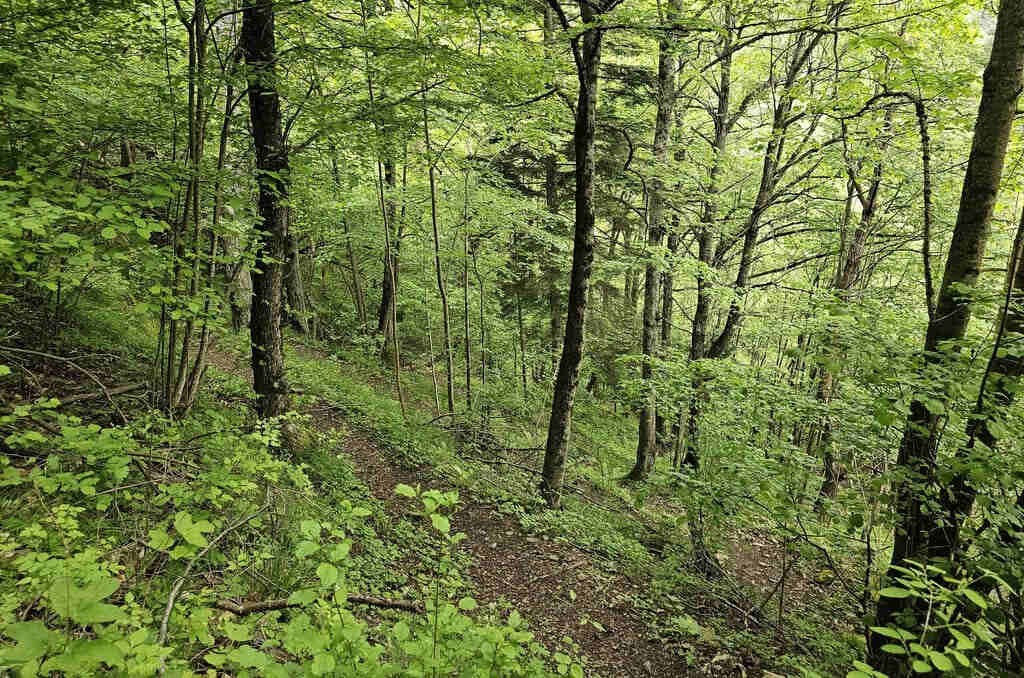
After Four à Chaux, the most challenging section of the entire trail to Notre Dame des Fontaines begins. For about a kilometer, the path climbs quite steeply through the woods, with an elevation gain of about 140 meters concentrated over a short distance. It’s not a particularly difficult climb, but it feels more strenuous than the first part of the hike, especially on hot days.
The stretch is still very pleasant to walk: the trail winds through lush greenery, past trees, rocks, and small streams, with several shaded spots that make the walk quite relaxing despite the climb.
What’s interesting is how the landscape gradually changes. The first part of the Interpretive Trail is more enclosed and wooded, but once you’ve climbed the hill, the valley slowly begins to open up. The vegetation thins out, offering wider views of the mountains of the Roya Valley, and you begin to catch glimpses of pastures, stone walls, and old farmhouses scattered across the slopes.
The final stretch before the finish, however, slopes slightly downward and leads toward Notre Dame des Fontaines through a much more open and sunlit area. It is right here that the sanctuary appears almost suddenly, nestled between mountains and woods at the edge of the valley.
And this is probably the most unique part of the entire hike. After several kilometers surrounded by nature, the church appears rather simple, almost unremarkable from the outside, and gives little hint of what lies within.
Notre Dame des Fontaines, the Sistine Chapel of the Maritime Alps[ back to menu ]
After passing through woods, streams, and ancient remnants of Brigasca culture, the arrival at Notre Dame des Fontaines completely changes the atmosphere of the journey. The sanctuary is located about 4 km from La Brigue, in a rather isolated part of the Roya Valley, surrounded by mountains and springs. From the outside, the church appears simple, almost rustic, with an appearance far removed from the idea of a grand, monumental sanctuary. And it is probably precisely this that makes the interior all the more surprising.
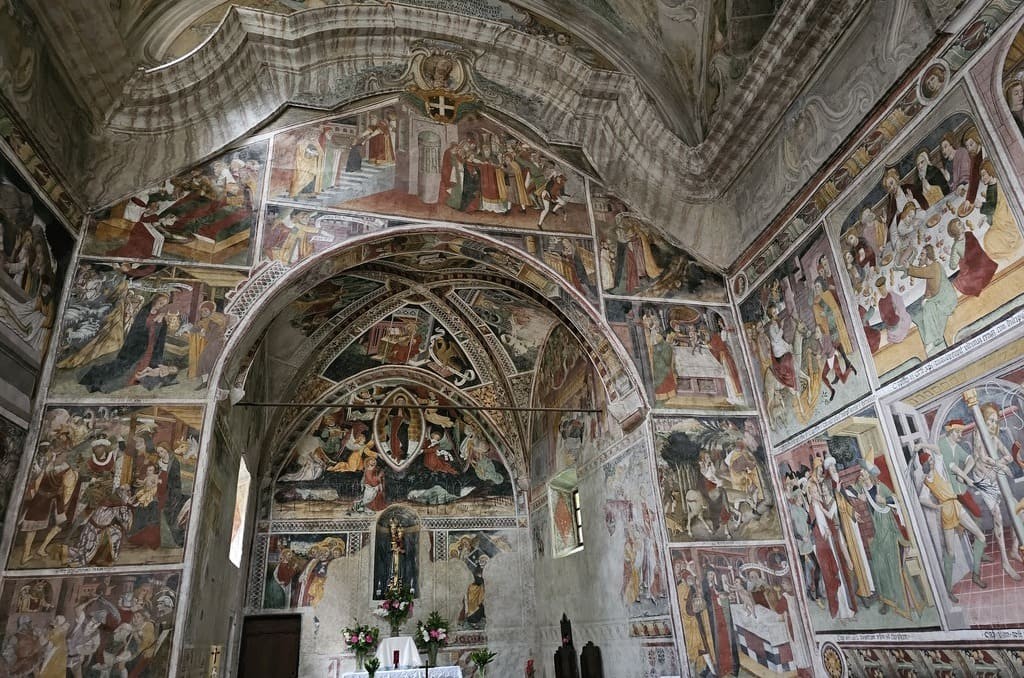
Once inside, visitors are greeted by one of the most important fresco cycles in the Maritime Alps; indeed, Notre Dame des Fontaines is often referred to as the “Sistine Chapel of the Maritime Alps.” The walls, vaults, and counter-façade are completely covered with scenes painted between the late 15th century and 1492 by Giovanni Canavesio and Giovanni Baleison.
The atmosphere here is very different from that of many other Alpine churches in the area: here, the frescoes don’t seem like mere decorations, but rather a vast visual narrative that completely envelops those who enter.
The interior of the Church of Notre Dame des Fontaines in La Brigue
Why is Notre Dame des Fontaines so famous?[ back to menu ]
The fame of Notre Dame des Fontaines stems primarily from the impressive state of preservation of its frescoes and the way they cover every inch of the chapel’s interior. There are virtually no empty walls: every surface depicts scenes from the life of Mary, the childhood of Jesus, the Passion of Christ, and the Last Judgment.
Most of the paintings were created by Giovanni Canavesio, a priest and painter from Pinerolo, while the choir was decorated by Giovanni Baleison a few years earlier, in 1481.
The frescoes also served a very practical purpose: to recount religious stories to a population that was largely illiterate. For this reason, Notre Dame des Fontaines is often referred to as a *Biblia Pauperum*, or “Bible of the Poor,” composed of images that are simple to understand yet emotionally powerful.
The contrast between the sanctuary’s austere exterior and the rich interior decoration is probably the most striking aspect of the visit. From the outside, one would hardly expect an artistic masterpiece of this caliber to be hidden away in such an isolated mountain valley.
Details of the interior of Notre Dame des Fontaines in La Brigue
The frescoes by Giovanni Canavesio and the Passion cycle[ back to menu ]
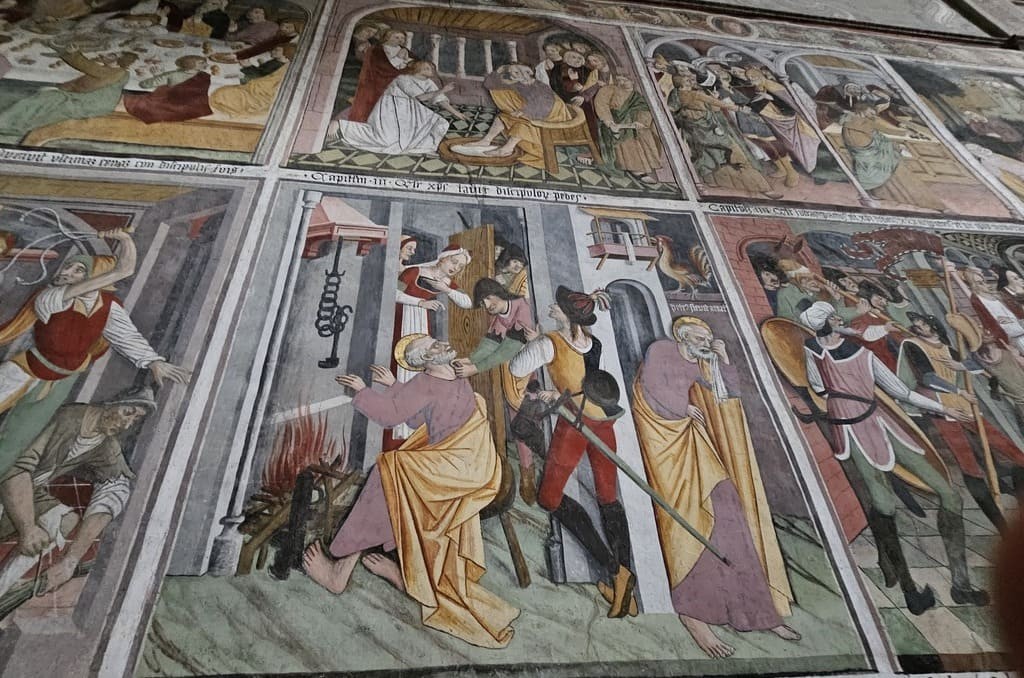
The most spectacular part of the chapel is probably the large cycle of paintings depicting the Passion of Christ, painted by Giovanni Canavesio in 1492. The scenes cover the entire length of the side walls and depict the final days of Jesus’ life with an impressive level of detail.
There is the Entry into Jerusalem, the Last Supper, Judas’ Betrayal, the Flagellation, Calvary, the Crucifixion, and the Resurrection, arranged as a long, continuous narrative that guides visitors through the entire chapel.
What makes these frescoes truly unique is the way Canavesio depicts the figures. Their expressions are highly theatrical, almost dramatic, and their faces convey anger, fear, pain, or despair with a realism that was remarkable for the time.
The style clearly bears the mark of Flemish influence, particularly in its attention to detail, its vivid colors, and its very realistic depiction of physical suffering. Some scenes are surprisingly raw and seem almost to foreshadow a more modern style compared to the traditional religious painting of the time.
It is also interesting to note how Canavesio uses the space of the chapel: the scenes do not simply appear to be hung on the walls, but rather form a continuous narrative that fully engages the visitor.
The Last Judgment at Notre Dame des Fontaines[ back to menu ]
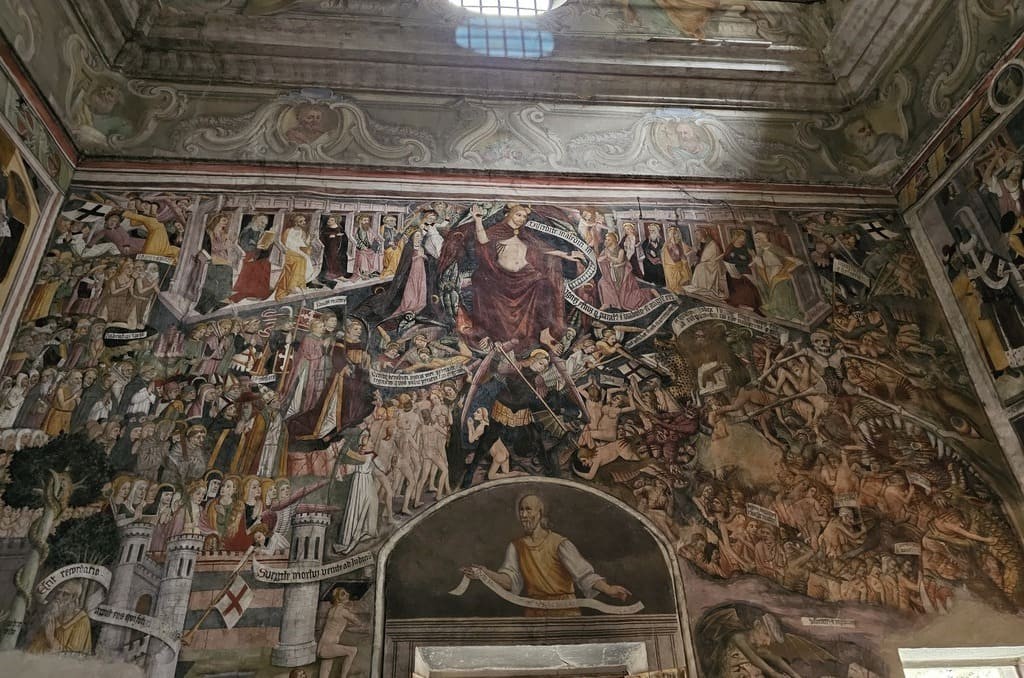
On the rear façade of the sanctuary is one of the most impressive works in all of Notre Dame des Fontaines: the gigantic "Last Judgment" painted by Giovanni Canavesio in 1492.
Unlike many other Renaissance depictions of the Last Judgment, the atmosphere here is much darker and more unsettling. Hell dominates much of the scene, with demons, monsters, and the damned subjected to extremely detailed tortures. Canavesio employs deliberately powerful and theatrical imagery, likely influenced by the medieval Passion plays that were performed in public squares.
One of the most striking features is the presence of Job right at the center of the composition, beneath St. Michael’s scales. This is a very rare iconographic choice: Job represents human suffering endured with faith and serves as a sort of symbolic link between earthly life and the final resurrection.
The depiction of the deadly sins is also very interesting. Each sin is punished with specific tortures according to the medieval principle of poetic justice: the greedy are forced to swallow molten gold, the envious are tormented by snakes, while other damned souls are devoured by monstrous creatures.
Hell itself appears as the gigantic, gaping mouth of Leviathan swallowing up sinners, creating a highly dynamic and chaotic composition that immediately catches the eye of anyone entering the chapel.
In some scenes, a small demon even appears, attempting to tamper with the weighing of souls by pulling St. Michael’s scales downward—a detail that is almost ironic but perfectly consistent with the strong theatricality of the entire series of paintings.
Overall, the Last Judgment at Notre Dame des Fontaines is striking above all for its emotional intensity. Rather than a solemn or contemplative image, it seems designed to frighten, engage, and leave a powerful impression on the worshippers who entered the chapel in the late 15th century.
The Seven Springs and the Legend of the Shrine[ back to menu ]
The location chosen for the construction of Notre Dame des Fontaines also has a very specific significance. The sanctuary stands above seven springs that have been considered miraculous by the residents of La Brigue for centuries.
According to legend, after an earthquake, the springs that supplied the village suddenly dried up, throwing the valley’s agriculture into crisis. The inhabitants then made a vow to the Virgin Mary, promising to build a large sanctuary if the water began to flow again.
When the springs began to flow again, the people of Briga kept their promise and built Notre Dame des Fontaines right where the water emerged from the mountain. Even today, part of the spring water flows into the Levenza River at the foot of the sanctuary.
There is a legend that beautifully illustrates the deep connection between these Alpine valleys and water: an element that is fundamental not only from a symbolic and religious perspective, but also for the daily survival of the communities in the Roya Valley.
Overview of the interior of Notre Dame des Fontaines in La Brigue
Visiting hours and ticket prices for Notre Dame des Fontaines[ back to menu ]
Notre Dame des Fontaines is open year-round, but hours vary by season. During the summer—from June 1 to September 30—the sanctuary is open daily from 10:00 AM to 12:30 PM and from 2:00 PM to 5:30 PM. Tickets can be purchased up to 30 minutes before closing time.
Thursdays are generally reserved for parish activities and religious services, so it’s always a good idea to check for any changes before your visit.
From October 1 to May 31, however, visits are by reservation only and subject to availability at the La Brigue tourist office.
As for prices:
- General admission: €4
- Guided tour (by reservation): €6
- Reduced student rate: €3 (self-guided tour) / €4 (guided tour)
- Free admission for children 12 and under
The guided tours last about an hour and, in our opinion, are definitely worth it, especially for gaining a better understanding of the meaning behind Canavesio’s frescoes and the iconographic details of the Last Judgment, which might otherwise go unnoticed.
For updates on schedules, seasonal openings, and reservations, we recommend checking the official Menton Riviera & Merveilles website or contacting the La Brigue tourist office directly.
The return to La Brigue through pastures, streams, and panoramic views of the Roya Valley[ back to menu ]
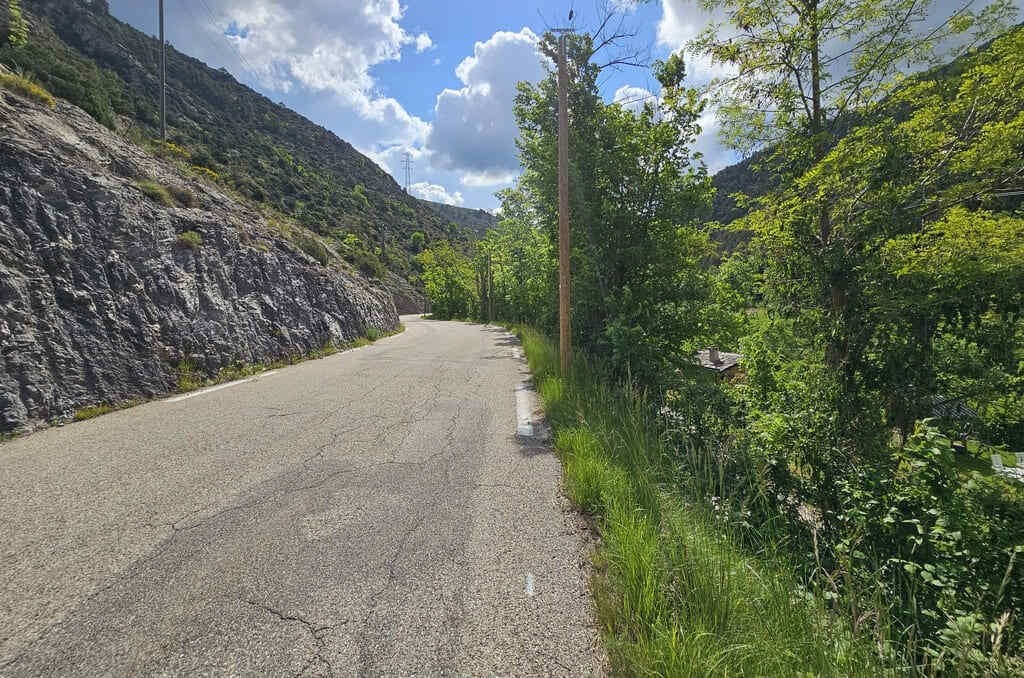
After visiting Notre Dame des Fontaines, the trail heads back toward La Brigue along a very quiet paved road that winds through a more open part of the valley. It’s a completely different stretch from the climb through the woods: the landscape changes once again, and the pace of the walk becomes much more relaxed.
After the visual intensity of the frescoes in Canavesio, this final stretch of the hike feels almost like a natural way to unwind. You walk through meadows and pastures, taking in sweeping views of the mountains of the Roya Valley, with the sound of the Levenza River accompanying you along the way at various points.
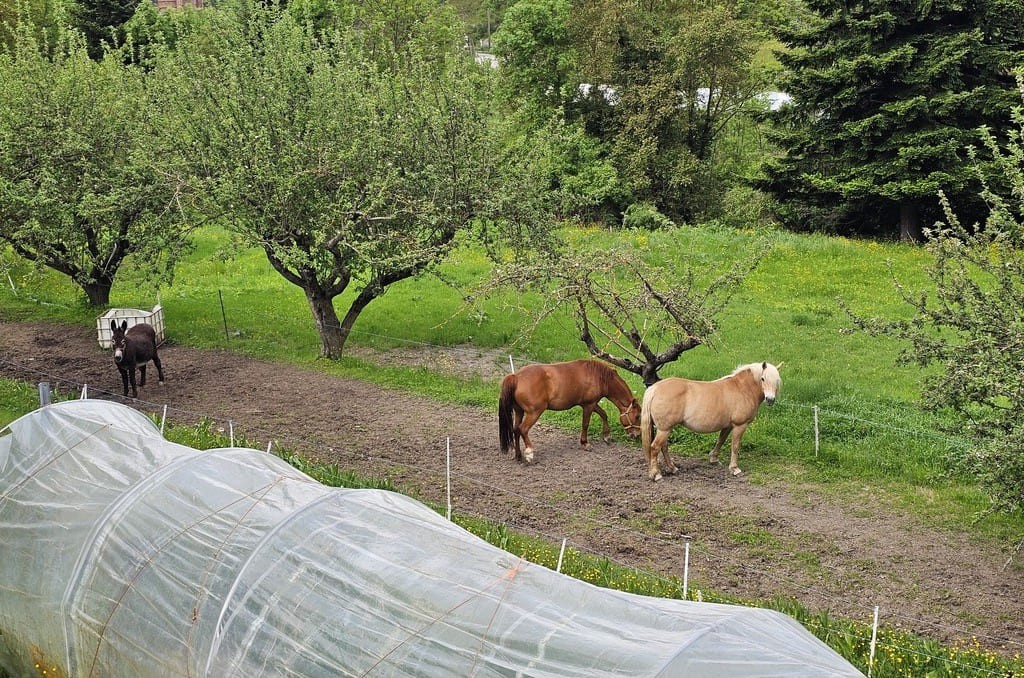
Along the way, we also came across some horses grazing and a donkey left to roam freely near an old farmhouse—simple details that help give the whole area a very authentic atmosphere, one that remains deeply rooted in mountain life.
As you approach La Brigue once more, the stone bridges, the houses clinging to the mountainside, and the stream running through the village come into view. And it is precisely at that moment that you realize just how different this trail is from many other Alpine hikes: it is not just a trek through nature, but a journey that truly tells the story of the history, water, art, and culture of one of the most unique border valleys between Italy and France.
The Way of Saint John: La Brigue – Return
Listen to all podcasts published on our official channels: