Villages of Liguria
What to See in La Brigue, the Medieval Border Village Perched Between Italy and France
May 24, 2026
Some villages seem to belong entirely to one country, while others give the impression of being caught in the middle. La Brigue is one of these. Today it lies in France, in the Roya Valley, but you only need to stroll through its cobblestone streets, read a few inscriptions, or look at the place names to immediately realize just how strong its ties to Italy still are.
Once known as Briga Marittima, La Brigue is a small medieval village surrounded by the Maritime Alps, traversed by the Levenza stream, and steeped in Alpine culture, Ligurian traditions, and border history. Here, in just a few minutes, you can go from elegant squares and Baroque chapels to forest trails leading to Notre Dame des Fontaines, considered by many to be the “Sistine Chapel of the Alps.”
What strikes you most, however, is probably the atmosphere. La Brigue doesn’t feel like a village built for tourism: it’s a lively, authentic town with a complex history and a very distinctive identity that’s evident almost everywhere, from the bilingual signs to the ancient trade routes that once connected Liguria, Piedmont, and the French Riviera.
Where is La Brigue, why visit the village, and how to get there
La Brigue is located in southern France, in the French Alpes-Maritimes, just a few kilometers from the Italian border and in the heart of the Roya Valley. Until 1947, however, this village belonged to Italy and was officially called Briga Marittima: a historical detail that is still very much evident here, both in the architecture and in the local language and traditions.
As you stroll through the historic center, you constantly come across elements that reflect this dual identity: monuments with inscriptions in Italian and French, Baroque chapels that strongly resemble those found in Liguria and Piedmont, and old trade routes that once connected the French Riviera to Piedmont, passing right through these mountains.
La Brigue is, in fact, one of the symbols of the so-called Tèra Brigasca, a border region in the Alps that for centuries has shared culture, language, and pastoral traditions with France, Liguria, and Piedmont. Even today, the Brigasca dialect is recognized as an Occitan linguistic minority in the neighboring Italian regions.
The village is nestled in a truly unique natural setting: mountains, streams, medieval bridges, and trails winding through the forests and valleys of the Roya. That’s precisely why, in our opinion, La Brigue is the perfect destination for anyone staying in western Liguria who wants to spend a day doing something different from the usual beach outing. From our farmhouse in Diano Marina, La Brigue can be reached in about two hours by traveling through one of the most charming border areas between Italy and France.
How to get to La Brigue
To reach La Brigue from Liguria, you must pass through Ventimiglia and travel up the Roya Valley, passing through several small mountain villages until you reach the heart of the French Maritime Alps. From our agritourism in Diano Marina, the trip is about 100 km, roughly 2 hours, and can easily be arranged as a day trip.
The road itself is already part of the experience: the landscape changes rapidly, passing through streams, stone bridges, narrow valleys, and villages that seem to hover between Italian and French culture. In recent years, we have also visited other beautiful villages in the Roya Valley, such as Saorgio and its monastery, and Breglio and the Torre Cruella, which are definitely worth a stop if you want to explore this border area between Liguria and France more thoroughly.
La Brigue may also be of interest to those returning to Piedmont via the Colle di Tenda Tunnel. In this case, it’s always a good idea to check the tunnel’s schedule and opening hours in advance on the official Colle di Tenda Tunnel website.
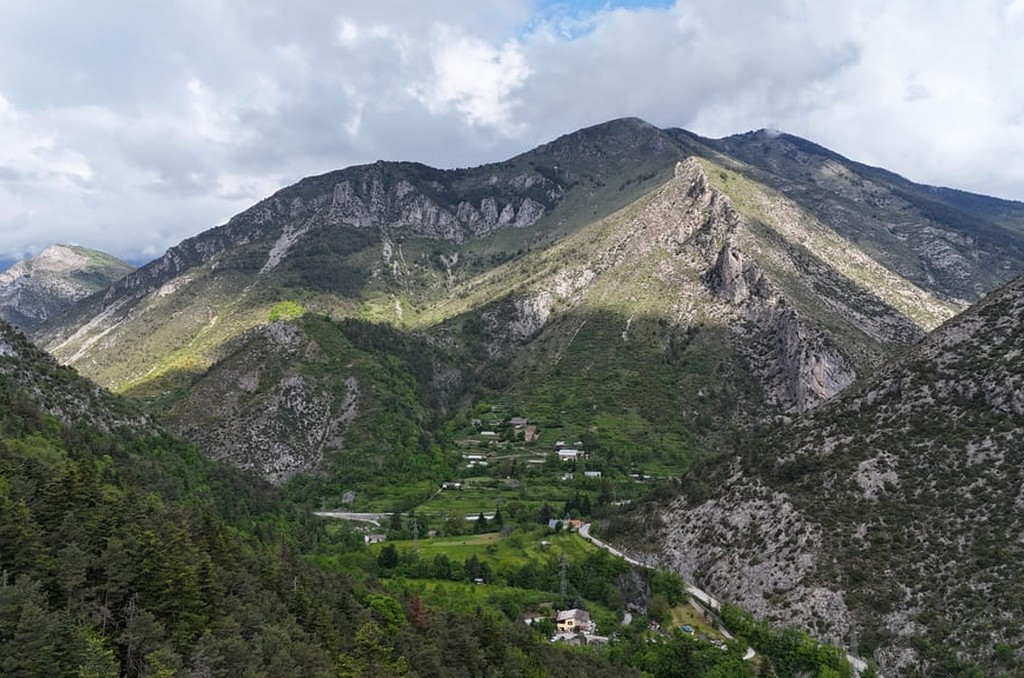
Mountain landscapes in La Brigue
What to see in the historic center of La Brigue
The historic center of La Brigue is quite small and can easily be explored on foot. With its cobblestone streets, stone houses, wooden balconies, and small Baroque chapels, the village still retains a very authentic atmosphere, a far cry from that of many of the more famous tourist destinations on the French Riviera.
What is particularly striking is the cultural mix: in some places, it almost feels like you’re in a small village in the Ligurian hinterland, while in others, more typically Alpine or French details come to the fore. This is no coincidence: for centuries, La Brigue has been an important commercial crossroads between the Roya Valley, Piedmont, and Liguria.
As you stroll through the village, you’ll constantly come across interesting little details: carved lintels, ancient bridges, pastel-colored facades, bilingual signs, and glimpses of the Levenza stream that runs through the village.
Place de Nice and the war memorial, between Italian and French
The heart of the village is Place de Nice, a spacious, well-ordered square surrounded by historic buildings, arcades, and facades painted in warm colors. Here, you can really sense La Brigue’s character as a “border village.”
In the center of the square stands the World War II memorial, likely one of the town’s most distinctive landmarks. What immediately catches the eye is the presence of inscriptions in both Italian and French: part of the monument dates back to the time when La Brigue was still Italian and was called Briga Marittima, while the later inscriptions recount the town’s transfer to France following the 1947 Treaty of Paris.
Even without knowing the full local history, you only need to read the plaques to understand how deeply the issue of the border is still embedded in the town’s identity.
The Baroque Chapels of the Penitents
Among the most distinctive buildings in the historic center are the ancient chapels of the Penitents’ brotherhoods, a testament to the strong religious tradition that has characterized La Brigue for centuries.
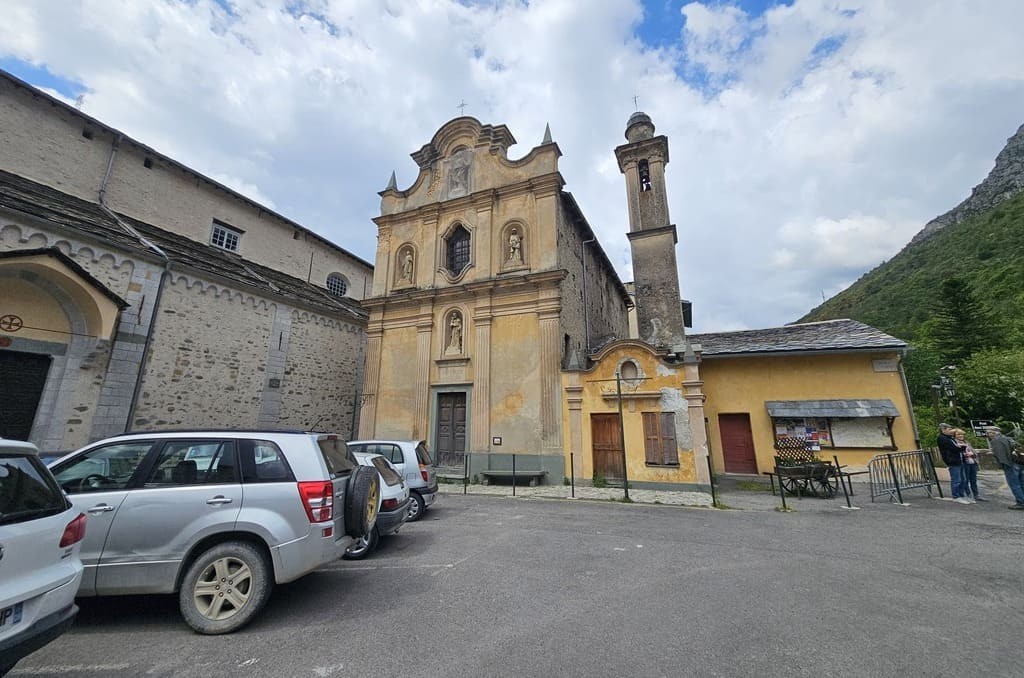
The most recognizable are the Chapel of the Annunciation, associated with the White Penitents, and the Chapel of St. Charles Borromeo, belonging to the Red Penitents. Both feature striking facades, with stone staircases, pastel colors, and designs that blend Baroque elements with Alpine religious architecture. In addition to these, there is the Chapel of the Assumption, located next to the Collegiate Church of San Martino.
Strolling through narrow alleys, past stone houses, and with views of the Levenza River
One of the most enjoyable things to do in La Brigue is simply to wander aimlessly through the streets of the historic center. Some of the narrow streets are very narrow and shaded, while others suddenly open up onto small open spaces or offer glimpses of the mountains of the Roya Valley.
The houses feature exposed stone, colorful shutters, and wooden balconies in the Alpine style, while the Levenza stream winds through the village, creating some truly unique spots, especially near the historic bridges.
There are also numerous informational signs scattered throughout the town that tell the story of the Tèra Brigasca, the ancient trade routes, and the historical ties between Liguria, Piedmont, and France. It is precisely this cultural interweaving that is likely the most interesting aspect of a visit to La Brigue.
The Levenza River in La Brigue
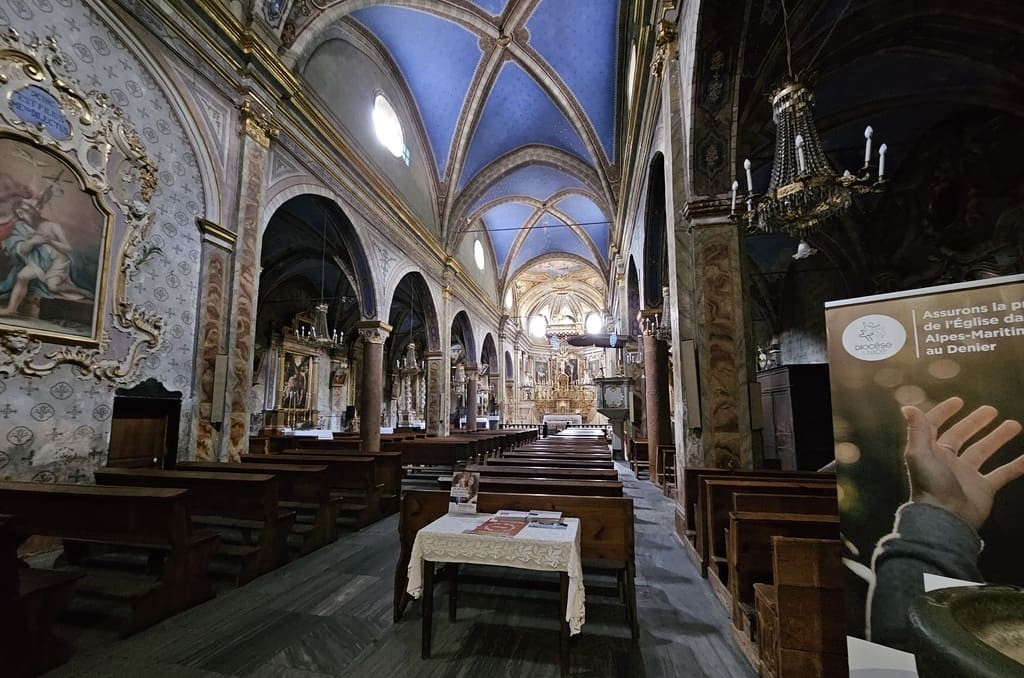
The Collegiate Church of Saint Martin, the religious heart of La Brigue
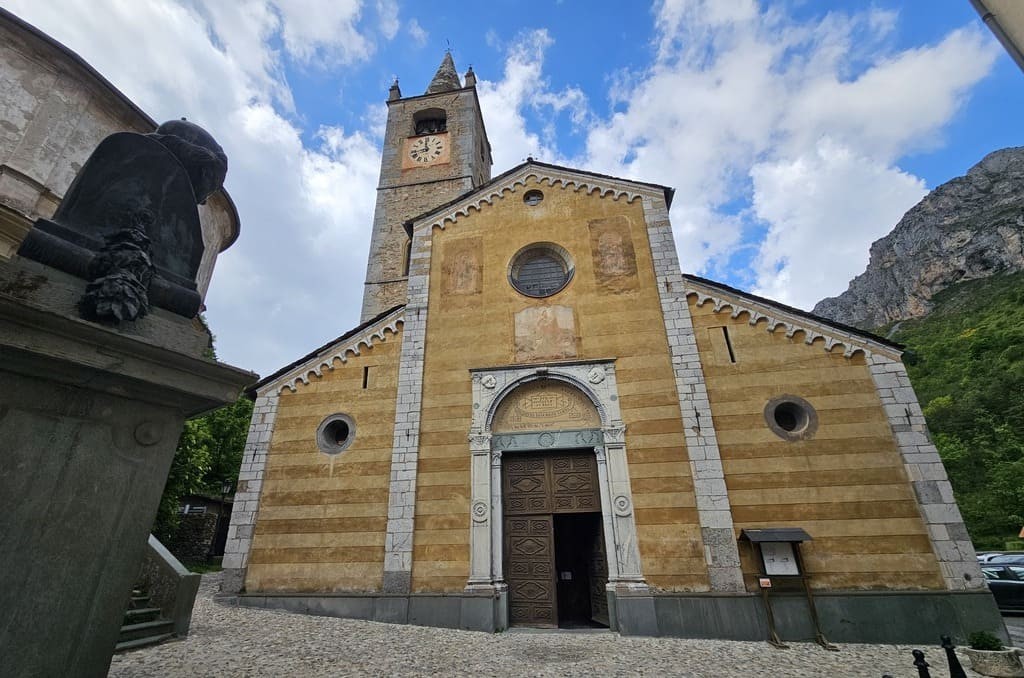
Among the sights to see in La Brigue, we must mention the Collegiate Church of Saint Martin, one of the village’s most important buildings. It is located just a short walk from Place de Nice, and it’s impossible to miss thanks to its slender Lombard-style bell tower, which dominates much of the historic center.
The current collegiate church dates primarily from the 16th century, but some parts are much older: the side portal, in fact, features a lintel from 1234, considered one of the oldest in the entire Roya Valley region. Over the centuries, the building has been modified several times, evolving from Romanesque-Lombard architecture to a much richer and more ornate interior, influenced by the Alpine Baroque style prevalent in Piedmont, Liguria, and southern France.
The church also houses several interesting works of art inside. The most famous is probably *The Nativity* by Louis Bréa, a highly influential painter active between the 15th and 16th centuries in the region spanning western Liguria, Provence, and the French Riviera. The work stands out for its rather unique composition and a style that combines narrative simplicity with symbolic details.
The historic Lingardi organ is also quite beautiful; it is one of the most important features of the collegiate church, along with the wooden decorations and 18th-century frescoes, which together create an interior that is surprisingly opulent given the village’s size.
The overall impression is that of being in a place that vividly reflects La Brigue’s past: a small, quiet village today, but one that for centuries served as a commercial and cultural crossroads significant enough to attract artists, artisans, and skilled workers from across the Alpine region between Italy and France.
The Pont du Coq, one of the most intriguing landmarks of La Brigue
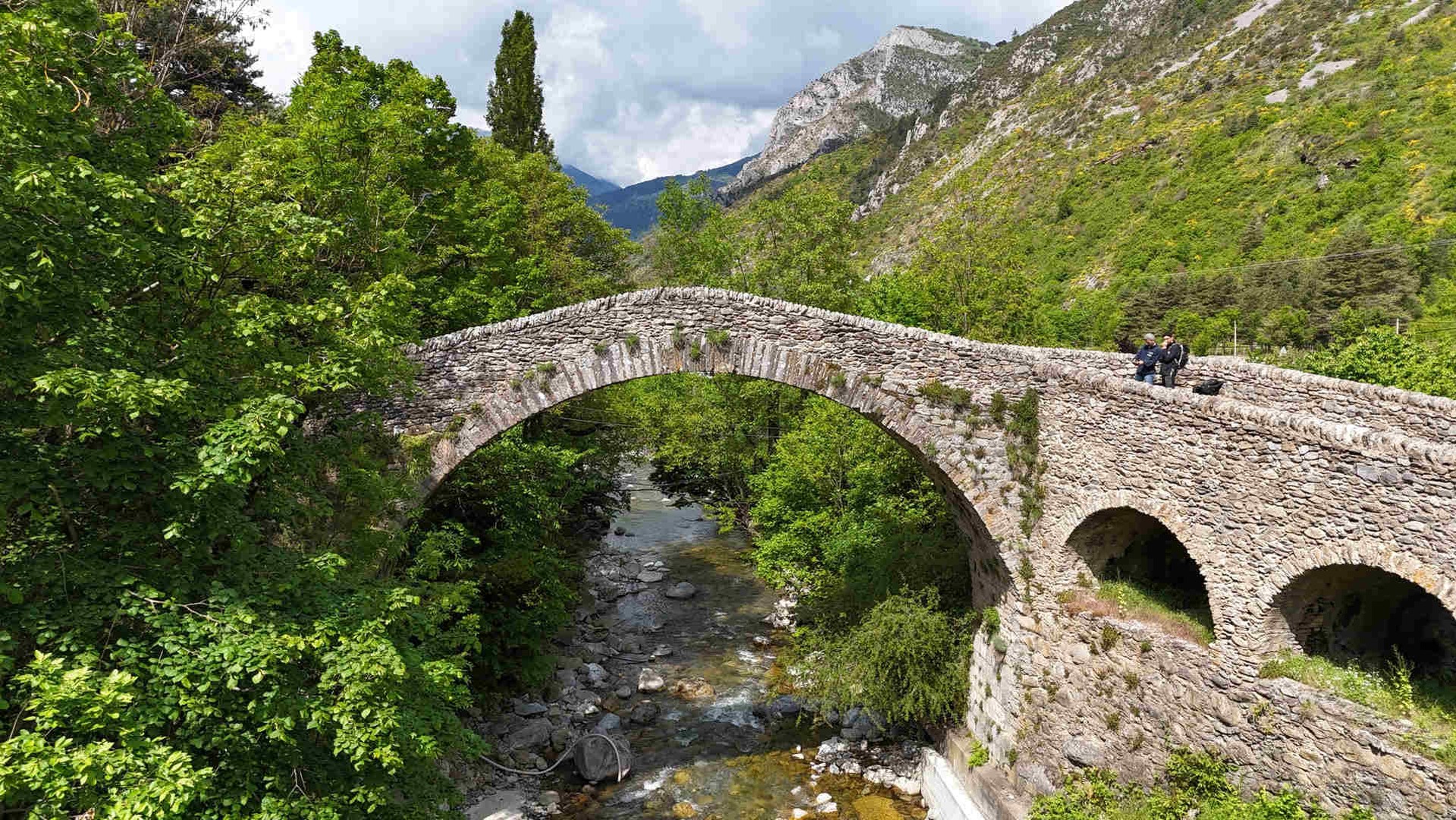
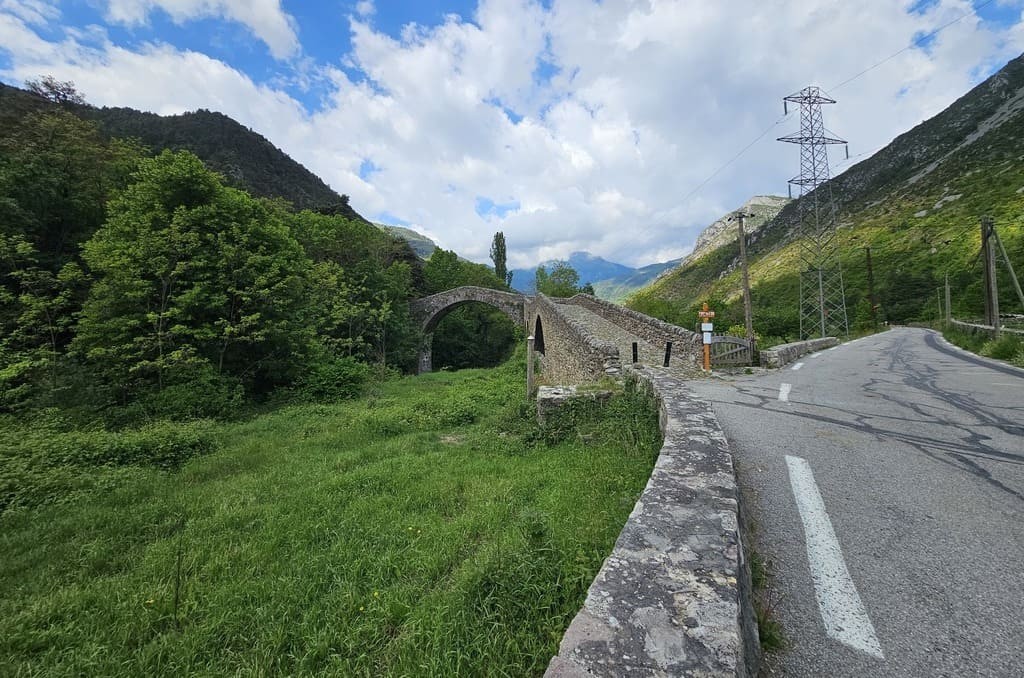
One of the most unique sights in La Brigue is undoubtedly the Pont du Coq, a historic stone bridge that spans the Levenza stream just outside the village center. At first glance, it might seem like “just” an old Alpine bridge, but it actually holds a surprising wealth of history, engineering, and local legends.
The current structure dates back to the early 18th century, after a flood destroyed the previous medieval bridge. The bridge was rebuilt by a family of stonemasons from Lugano, the Cometto family, who specialized in this type of mountain construction.
The feature that makes it instantly recognizable is its “humpback” shape, with a curious elbow-like bend. This is not a design flaw: that bend was actually intended to facilitate the passage and maneuvering of carts along the narrow Levenza Valley. Even today, the bridge retains a very picturesque appearance, especially when viewed from below with the stream flowing between the white rocks of the valley.
In recent years, the Pont du Coq has returned to the spotlight, partly due to Storm Alex, which in October 2020 devastated much of the Roya Valley, causing extensive damage to roads, bridges, and villages in the area. The restoration and enhancement of the area were also supported by the Prince Albert II of Monaco Foundation, which contributed to the restoration of the nature and history trail around the bridge.
Today, the Pont du Coq remains one of the most photographed landmarks in La Brigue and perfectly captures the character of the village: a small, seemingly isolated place, yet with a history far more significant and complex than one might imagine at first glance.
The Legends of the Pont du Coq: Roosters, Dragons, and Spirits
As is often the case in mountain villages, various folk legends have emerged over time around the Pont du Coq, blending superstition, religion, and stories passed down orally. And this is probably what makes the bridge so fascinating.
The best-known legend tells that during the construction of the bridge, the inhabitants of La Brigue suddenly ran out of the stones needed to complete the work. A rooster is said to have indicated where to find them by scratching at the ground, revealing a hidden quarry. This is said to be the origin of the name “Pont du Coq,” meaning “Rooster Bridge.” According to a more plausible interpretation, the term “coq” derives from an ancient local word related to the angular shape of the bridge itself.
However, there are also much darker tales. One tells of a dragon hiding near the valley, defeated by a knight who is said to have cleared the path to the village. Another legend, on the other hand, tells of a restless spirit linked to the Levenza stream and of an ancient ritual sacrifice of a rooster to appease it.
Legends aside, the Pont du Coq truly has something special about it. Thanks to the bridge’s angular shape, the sound of the Levenza River, and the valley’s rugged, untamed setting, it is one of those places that seem tailor-made for giving rise to tales and folk stories.
The magnificent Pont du Coq in La Brigue
The Shrine of Notre Dame des Fontaines
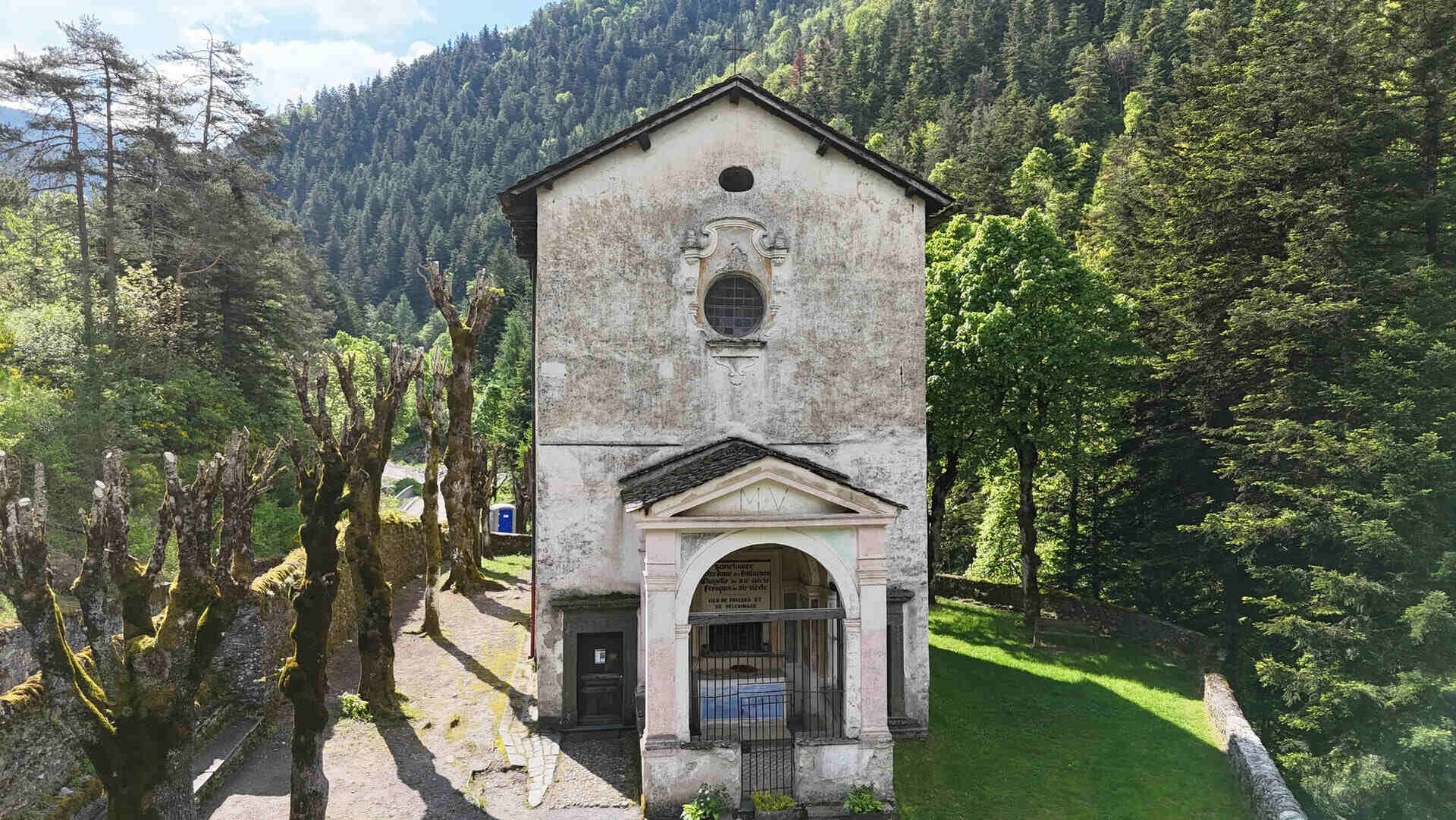
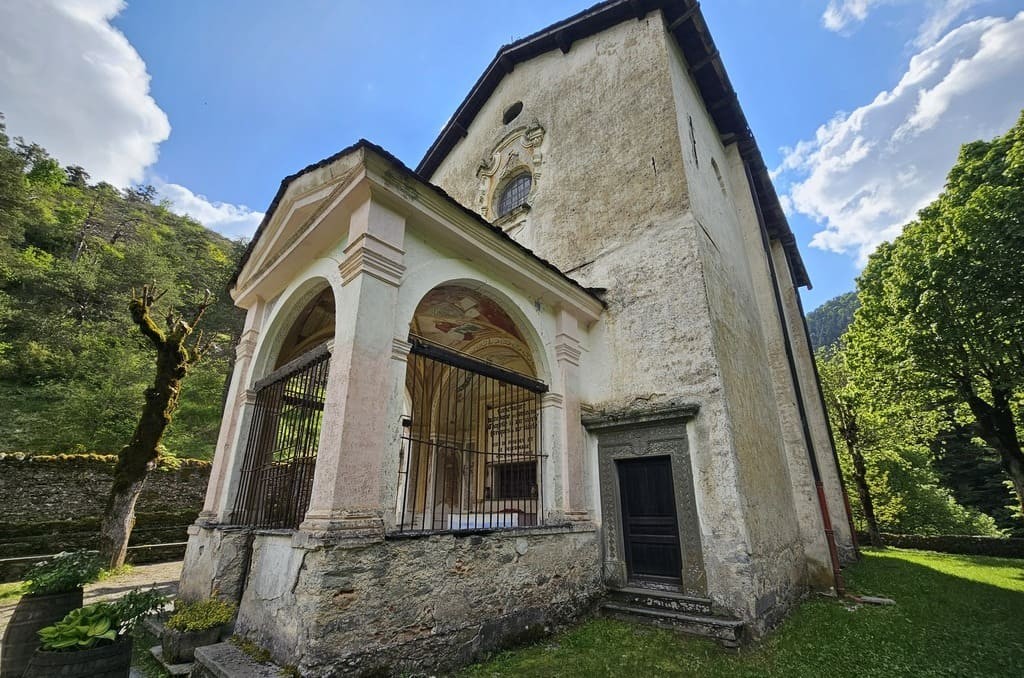
Just a few kilometers from the center of La Brigue lies Notre Dame des Fontaines, one of the most famous and striking sites in the Roya Valley. From the outside, the sanctuary appears very simple, almost hidden among the woods, mountains, and streams, but one need only step inside to understand why it is considered one of the most important artistic treasures of the Alpes-Maritimes.
The interior of the church is entirely covered with 15th-century frescoes by Giovanni Canavesio and Giovanni Baleison, depicting scenes from the Passion of Christ, the life of the Virgin Mary, and the famous Last Judgment. The contrast between the austere exterior and the opulent interior is probably the most striking aspect of the visit.
You can also reach Notre Dame des Fontaines on foot via one of the most interesting routes in the area—a trail that winds through woods, crosses historic bridges, passes by old lime kilns, and offers views of the Levenza River, offering a vivid glimpse into the history and culture of the Tèra Brigasca. We chose this very route, which starts in the village of La Brigue and leads all the way to the sanctuary, passing through a particularly beautiful stretch of the Roya Valley.
If you’d like to learn more about the trail, the frescoes in Canavesio, and the history of the church, we cover these topics in greater detail in the article dedicated to the Notre Dame des Fontaines trail and sanctuary.
Why does La Brigue have such a distinctive identity?
To truly understand La Brigue, it’s important to remember that until 1947, this village was Italian and was called Briga Marittima. It was only after the Treaty of Paris, at the end of World War II, that the village officially became part of France along with other territories in the Roya Valley.
In reality, however, the history of La Brigue has always been linked to the concept of a border. For centuries, the village served as an important crossing point between Liguria, Piedmont, and the French Riviera, thanks to the ancient mule trails that connected the Roya Valley with the Tanaro and Nervia valleys.
Between the 14th and 16th centuries, the village flourished under the rule of the Lascaris family of Briga, becoming a small Alpine trading hub frequented by merchants, travelers, and shepherds. Even today, this history is evident as you stroll through the village: in the stone-carved doorways, the Baroque chapels, the Italian street names, and even in the local dialect.
La Brigue is, in fact, part of the so-called Tèra Brigasca, an Alpine cultural region that encompasses several valleys now divided among France, Liguria, and Piedmont. Here, pastoral traditions, words from the Brigasca dialect, and an identity that is quite distinct from both the French and the more coastal Ligurian cultures still thrive.
And that is probably exactly why La Brigue leaves such a unique impression on visitors: it doesn’t feel entirely French, nor does it feel truly Italian. It is a mountain village that has absorbed various influences over time, yet has retained a character all its own.
Breathtaking views in La Brigue
Listen to all podcasts published on our official channels: