Villages of Liguria
Rocchetta Nervina: What to See, Lakes, Canyoning, and Hiking in Val Nervia
March 29, 2026
Rocchetta Nervina is one of those villages in the Ligurian hinterland that immediately wins you over. Small, intimate, and crisscrossed by clear waters, it is located in the Nervia Valley, in the hinterland of Ventimiglia, and is known primarily for two reasons: its stunningly colored lakes and canyoning in the Rio Barbaira, one of the area’s most popular activities.
But Rocchetta Nervina isn’t just a destination for those seeking dives, gorges, and adrenaline. The village also has a quieter side, made up of stone-paved alleys, views of the stream, hiking trails, and very evident traces of its history. Just arriving at the village entrance makes it clear that nature and the village have always coexisted here, and that this very balance is one of the most beautiful aspects of the visit.
Discover what to see in Rocchetta Nervina, how to reach the small lakes, what you need to know about canyoning, and the village’s points of interest—not to mention the hiking trails and some fascinating facts about its history.
- Where is Rocchetta Nervina (Liguria) and how to get there
- Visit Rocchetta Nervina, Imperia: a village in the Nervia Valley
- Hiking in Rocchetta Nervina: trails and routes in the Ligurian Alps
- The medieval bridge of Rocchetta Nervina and the Rio Barbaira
- The Rocchetta Nervina Lakes: what to expect and how to get there
- Canyoning in Rocchetta Nervina: an experience in the Rio Barbaira
- What to see in the village of Rocchetta Nervina
- Walk along the Barbaira stream
- History and traditions: the “E Dubarie” trail
- The mills and hemp processing
Where is Rocchetta Nervina (Liguria) and how to get there [ back to menu ]
Rocchetta Nervina is located in the inland region of Western Liguria, in the province of Imperia, within the Nervia Valley—a valley that stretches behind Ventimiglia and is home to some of the area’s most picturesque villages.
The village is surrounded by lush greenery and traversed by the Barbaira stream, which helps create the natural setting that makes it so unique. Despite its inland location, it is easily accessible by car and makes for an ideal day trip destination, especially if you’re already on the coast.
Looking for a vacation apartment with a sea view? Our agriturismo is a great starting point for exploring the Ligurian hinterland and the Nervia Valley: expect a drive of about 70 km. The route is simple: take the A10 highway to Ventimiglia, then head up the valley following the signs for Dolceacqua and, subsequently, for Rocchetta Nervina.
Once you arrive, you’ll find several parking lots at the entrance to the village. They’re quite spacious and designed to accommodate the flow of visitors, especially during the warmer months when the area is very popular for its lakes and outdoor activities.
Visit Rocchetta Nervina, Imperia: a village in the Nervia Valley [ back to menu ]
Rocchetta Nervina is a small village in the Ligurian hinterland that retains a neat and authentic appearance, much like other towns in the Nervia Valley, but with a strong focus on tourism centered around nature and outdoor activities.
As soon as you arrive, you immediately notice how the village is organized to welcome visitors, including those from outside Italy. The parking lots at the entrance are spacious and well-distributed, a sign of significant tourist traffic, especially during the warmer months, when the small lakes and canyoning attract people from all over Europe.
Rocchetta is part of a broader landscape of very picturesque villages, some of which we’ve already featured on the blog, such as Dolceacqua, Apricale, and Pigna. Compared to these, it has a slightly different identity: less tied solely to the village itself and more focused on outdoor experiences.
Another aspect that stands out immediately is its connection to the territory of the Ligurian Alps Regional Nature Park. At the entrance to the village, there are information panels detailing various hiking trails, a sign that Rocchetta Nervina is not just a destination to visit, but also a starting point for exploring the valley on foot, along scenic paths and more challenging routes.
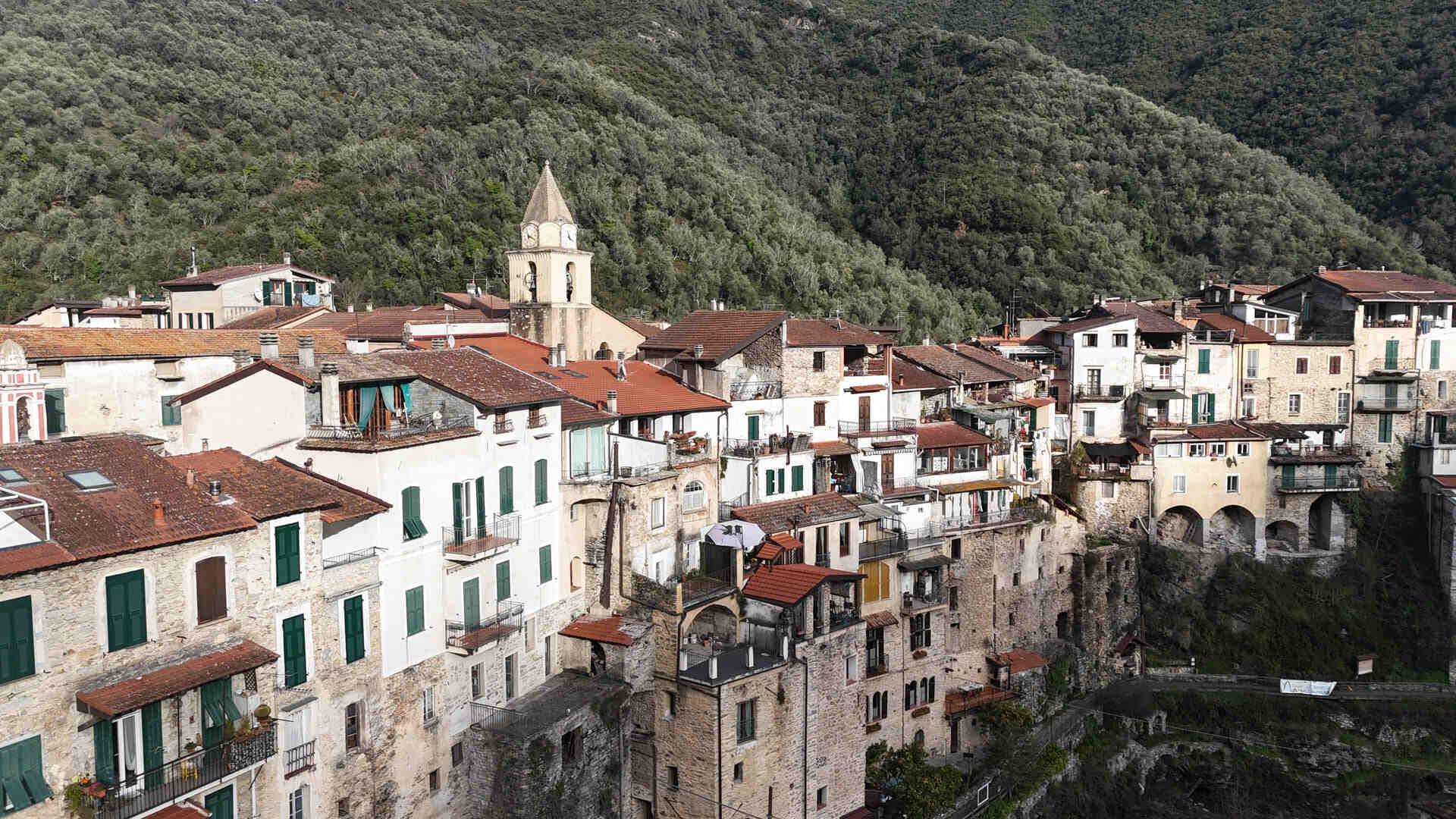
Panorama of Rocchetta Nervina
Hiking in Rocchetta Nervina: trails and routes in the Ligurian Alps [ back to menu ]
Rocchetta Nervina isn’t just about small lakes and canyoning. As soon as you enter the village, it’s clear that it’s also an excellent starting point for hiking, thanks to the many trails that are part of the Ligurian Alps Regional Nature Park network.
An information panel lists various trails—some more challenging and others more accessible—that allow you to explore the entire valley and venture up to the highest areas, through forests and along scenic ridges.
The main routes in the Ligurian Alps Natural Park[ back to menu ]
The marked trails vary greatly in distance and elevation gain, but they all have one thing in common: they start (or pass through) Rocchetta Nervina and allow you to fully immerse yourself in the landscape of the Ligurian hinterland.
Here are the main ones:
-
Trail 125 – Colla Melosa (1,540 m) – Triora (780 m)
Length: 14 km
Elevation gain: 900 m
Time: 3 h 45 min -
Trail 126 – Rocchetta Nervina Loop
Length: 25.7 km
Elevation gain: 1760 m
Time: approx. 10 hours -
Trail 133V – Pigna Loop
Length: 17.3 km
Elevation gain: 1,300 m
Time: 6 hrs 45 min -
Trail 156C – Rocchetta Nervina – Fontana Povera (connection to the Alta Via dei Monti Liguri)
Length: 5.3 km
Elevation gain: 970 m
Time: 3 hrs 30 min -
Trail 157C – Pigna – Muratone Pass (connection to the Alta Via dei Monti Liguri)
Length: 7.1 km
Elevation gain: 950 m
Time: 3 hrs 45 min
Other routes of the Ligurian Hiking Network (REL)[ back to menu ]
In addition to the park’s trails, Rocchetta Nervina is also connected to the Ligurian Hiking Network, with several trails crossing the valley and the surrounding hills.
Among the main ones:
- Trail 101 – Balcone Trail
- Trail 103 – Alpi del Mare 1
- Trail 114 – Colombin Loop
- Trail 116 – Gramondo Loop
- Trail 131 – Buggio – Prearba – Pigna
- Trail 132 – Valle delle Tane Loop
- Trail 131C – Prearba – Prati del Toraggio
- Trail 134C – Ponte Bausson – Orvegno – Voigiera
The 3 main trails you should know[ back to menu ]
Of all the available routes, three stand out for their interest, views, and variety.
Rocchetta Nervina Loop (Trail 126)[ back to menu ]
This is the most comprehensive and challenging route in the area. At 25.7 km long with a significant elevation gain of 1,760 meters, it is designed for experienced hikers.
The trail starts from the village, climbs toward Monte Tercai, and reaches the Sella di Gouta, offering sweeping views that stretch from the mountains all the way to the sea. It is a long hike (about 10 hours), but it allows you to experience very diverse environments, from Mediterranean scrub to the more inland forests.
Balcone Trail (Trail 101)[ back to menu ]
It is one of the most scenic trails in the area and is particularly popular with landscape photographers.
It winds halfway up the mountainside, offering unobstructed views of the valleys and surrounding peaks. While less challenging than the full loop, it is undeniably picturesque thanks to the stunning views it offers along the entire route.
Pigna Loop (Trail 133V)[ back to menu ]
This route connects two villages in the Nervia Valley, Pigna and Rocchetta, passing through Ponte Bausson.
It is a moderately difficult hike, with 1,300 meters of elevation gain and a duration of approximately 6 hours and 45 minutes. Along the way, you’ll encounter several points of interest, such as the Church of Sant’Antonio and the Sanctuary of the Madonna di Passoscio, as well as areas characterized by olive groves, stone bridges, and traces of rural life.
It’s a good compromise between a simple stroll and a more structured hike.
The medieval bridge of Rocchetta Nervina and the Rio Barbaira [ back to menu ]
The medieval bridge of Rocchetta Nervina is one of the village’s most recognizable landmarks, as well as one of the most photographed in all of western Liguria. It is located right at the entrance to the village and spans the Barbaira stream, effectively marking the passage into the historic center.
It is a medieval stone bridge with a single arch, characterized by the typical “humpback” shape: raised high in the center and sloping toward the sides. This design is not random but served to better withstand the torrent’s floods and to facilitate passage along the ancient mule tracks that connected the coast with the hinterland.
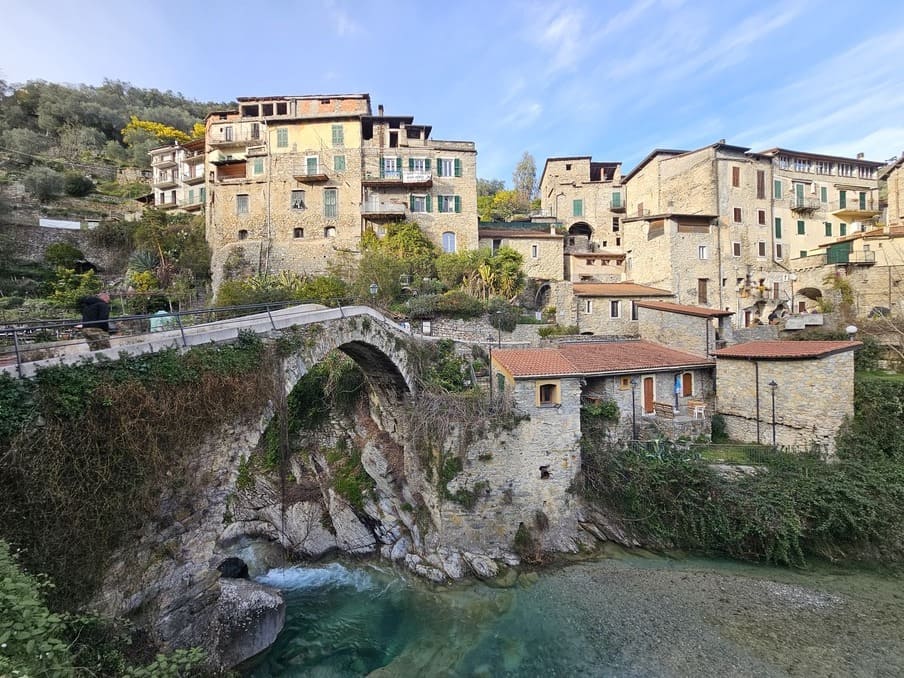
In the past, it also served a strategic purpose. Rocchetta Nervina is situated in a unique location, at the confluence of two rivers—the Barbaira and the Oggia—forming a “Y” shape. The bridge thus served as a key access point for controlling the territory and trade routes.
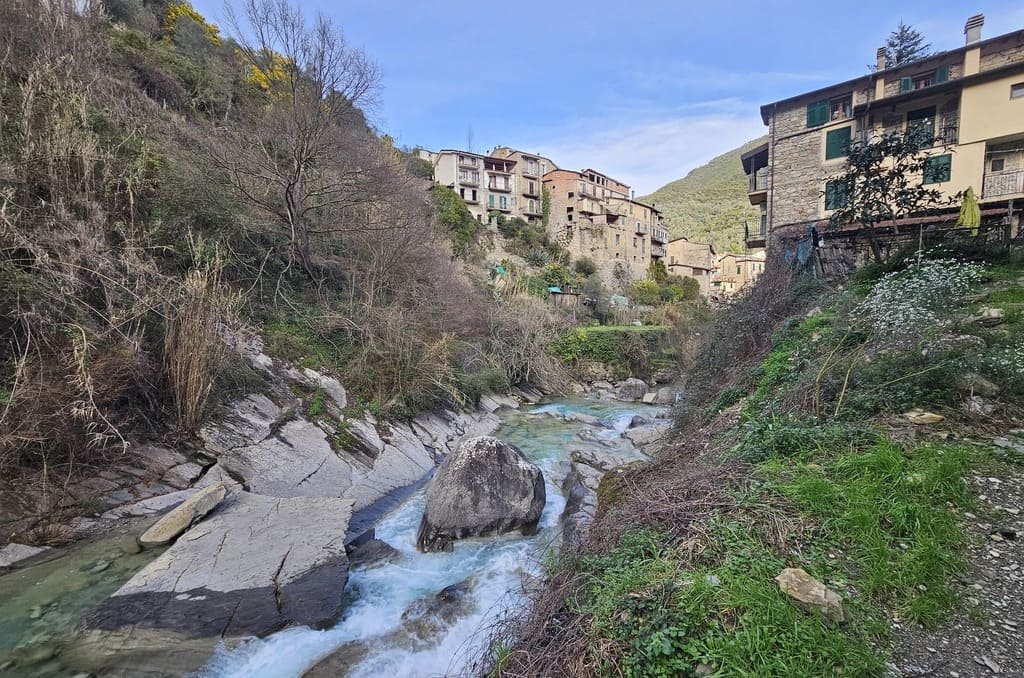
Beneath the bridge lie the first small lakes, among the easiest to reach. The waters are clear, with emerald-green reflections, and immediately create a striking contrast with the stone houses of the village. It is one of the most popular spots in summer, both for swimming and simply for stopping to admire the scenery.
The bridge also serves as an important landmark for canyoning enthusiasts: this is where the most famous stretch of the Rio Barbaira begins (or ends, depending on the route), featuring narrow gorges, waterfalls, and passages carved into the rock.
The Rocchetta Nervina Bridge
The Rocchetta Nervina Lakes: what to expect and how to get there [ back to menu ]
The Rocchetta Nervina pools are the village’s main natural attraction and one of the reasons why, especially in summer, the area fills with visitors.
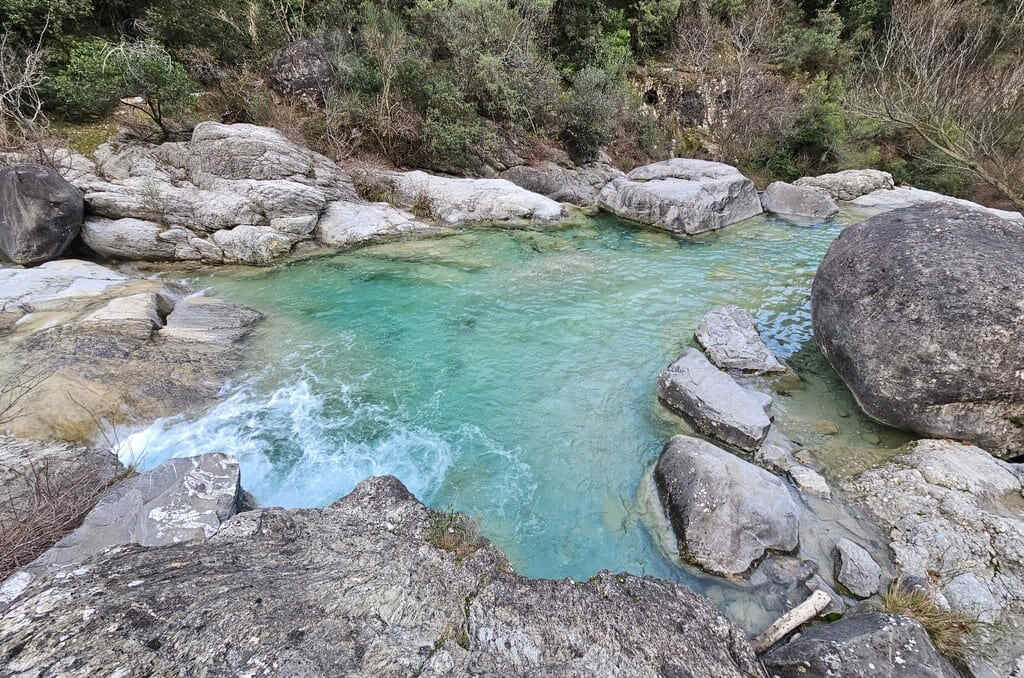
These are natural pools formed by the Barbaira stream, which over time has carved out the limestone rock, creating basins of crystal-clear water in vivid shades ranging from emerald green to deep blue. From the very first glimpse, it’s clear why this place is so beloved: the water is crystal-clear, and the setting has remained very natural.
Even off-season, as in my case in February, the view is striking. The stream flows between smooth rocks, creating a very pleasant atmosphere—perfect even just for a stroll.
In summer, however, the pools become a go-to spot for those seeking a bit of cool relief. The water is always quite cold, even in the hottest months, but that’s precisely why it’s so appreciated after a hike or on sweltering days. Many areas are arranged on multiple levels, almost like small natural pools, where you can stop, take a dip, or simply relax on the rocks.
The atmosphere is unique: it almost feels like you’re in a setting more exotic than typical of Liguria, but with the advantage of being easily accessible and set within a well-maintained environment.
Rocchetta Nervina, the ponds
How to get to the lakes and the route[ back to menu ]
Getting to the Rocchetta Nervina ponds is quick and easy, which is one of the reasons this destination is so popular.
The starting point is the medieval bridge at the entrance to the village. From here, take the trail on the left, which is clearly visible and easy to follow right from the start.
The route is short: the lakes are about 700 meters away and can be reached in 5–6 minutes on foot. The trail runs mostly alongside the Barbaira stream, offering continuous views of the clear water and rocks.
Hiking trail to the Rocchetta Lakes
In terms of difficulty, this is an easy and accessible trail, but it should not be underestimated.
The terrain consists of rocks and uneven sections, so it is recommended that you wear appropriate footwear with good traction. Even if there is no mud, there is a real risk of slipping, especially near the water. At the start of the trail, there is a sign (in Italian and English) warning of this very danger: you must be careful because there are no guardrails on the downhill side.
The beautiful ponds of Rocchetta Nervina
Useful tips for visiting the lakes[ back to menu ]
The Rocchetta Nervina ponds are easy to reach, but there are a few things you should know before going, especially if you visit in the summer.
The water is always very cold, even in the hottest months. It might seem refreshing on sweltering days, but the initial shock isn’t exactly pleasant, so it’s best to get in slowly.
During peak season, especially between July and August, the ponds closest to the village are very crowded. Since they’re the most accessible, they tend to fill up quickly throughout the day. If you’re looking for a bit more peace and quiet, it’s best to continue along the trail past the first few spots. It only takes an extra 15–20 minutes to find less crowded and much more relaxing areas.
From a safety perspective, it’s important not to underestimate the environment. The rocks can be slippery, and the water—in addition to being cold—can become challenging in some sections. If you decide to go canyoning, it’s essential not to improvise: you’ll need proper equipment and, above all, an experienced guide.
Canyoning in Rocchetta Nervina: an experience in the Rio Barbaira [ back to menu ]
Canyoning is one of the main reasons Rocchetta Nervina has become so well-known, even outside of Italy.
The Rio Barbaira is, in fact, considered one of the most beautiful routes in Europe for this type of activity, thanks to its combination of clear water, narrow gorges, and spectacular natural passages.
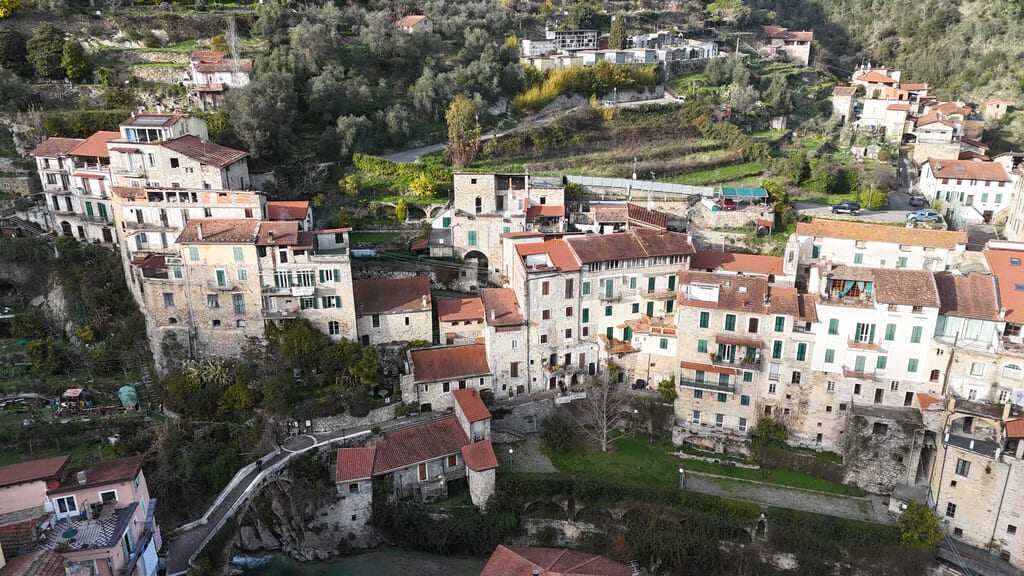
Even without trying it yourself, simply observing the surroundings (especially from above) is enough to understand the type of environment in which it takes place: a succession of natural pools, rocky walls, and sunken sections that make the route varied and never monotonous.
Rocchetta Nervina as seen from above
Why the Rio Barbaira is among the best canyons in Europe[ back to menu ]
The canyoning section of the Rio Barbaira winds through gorges carved into the rock, with water that is always present and very clean.
The route is not a simple descent, but a mix of:
- jumps (up to about 10 meters, never mandatory)
- natural rock slides (so-called toboggans)
- rope descents down waterfalls
It is considered a medium-easy route: suitable even for first-timers, provided they are accompanied by a guide, but it still requires a good comfort level with water and a lack of fear of heights.
The total duration of the activity is about 3–4 hours and ends right at the small lakes near the village, where you can stop to relax after the route.
Prices, booking, and practical information[ back to menu ]
The average cost of canyoning in Rocchetta Nervina ranges from €70 to €85 per person.
The price generally includes:
- guide
- wetsuit
- helmet
- harness
- insurance
To access the area, you’ll also need to purchase amunicipal ticket for about €4, which goes toward maintaining the trails and the area (this is often already included in the price, but it’s best to check).
The activity is generally available from April to October, when water conditions are most suitable.
Key requirements include:
- knowing how to swim
- being in reasonably good physical shape
- minimum age generally between 12 and 14 years old (depending on the operator)
It is recommended to bring a swimsuit, sneakers for use in the water, and everything needed to change clothes after the activity.
The ponds, like natural swimming pools in Rocchetta Nervina
Where to book canyoning in Rocchetta Nervina[ back to menu ]
There are several options for organizing your trip. One of the simplest is to book online through platforms like Freedome , which offer all-inclusive packages with equipment provided and centralized booking management.
Here are the main resources for organizing your trip:
1. Guides and Specialized Operators (Recommended)[ back to menu ]
Contacting the guides directly is often the best way to get real-time information on water conditions:
Canyoning Liguria: They are among the most active in the area.
Phone: +39 320 4374089
Email: info@canyoningliguria.com
RioBarbaira.it: A website dedicated exclusively to this canyon. It offers technical details and contact information for reservations.
Email: acolarn23@gmail.com
Itaca Canyoning:
Phone: +39 328 4697777
2. Online Booking (Portals)[ back to menu ]
If you prefer to book everything online with instant confirmation, you can use these websites:
Freedome or CheckYeti: They offer all-inclusive packages (often starting at around €70–85 per person) that include a guide, equipment, and insurance.
Yumping: Another popular website for adventure sports in Liguria.
The main difference between the various options mainly concerns the equipment and the level of self-sufficiency required. Some operators include everything in the price, while others cater to those who are already equipped and experienced.
If you’ve never gone canyoning before, it makes sense to choose a complete package—even if it costs a bit more—so that all the equipment is provided and the experience is easier to manage.
Nature in Rocchetta Nervina
What to see in the village of Rocchetta Nervina [ back to menu ]
After visiting the lakes, it’s worth spending a little time exploring the village as well. Rocchetta Nervina is small and easy to get around, but it still offers some interesting views and a few historical landmarks.
Via Roma and the narrow alleys[ back to menu ]
From the main bridge, you enter the village and take Via Roma, the street that runs through the center. From here, the classic caruggi—the narrow alleys typical of Ligurian villages—branch off, with passages between stone houses, small squares, and simple details like painted doors and glimpses of the stream.
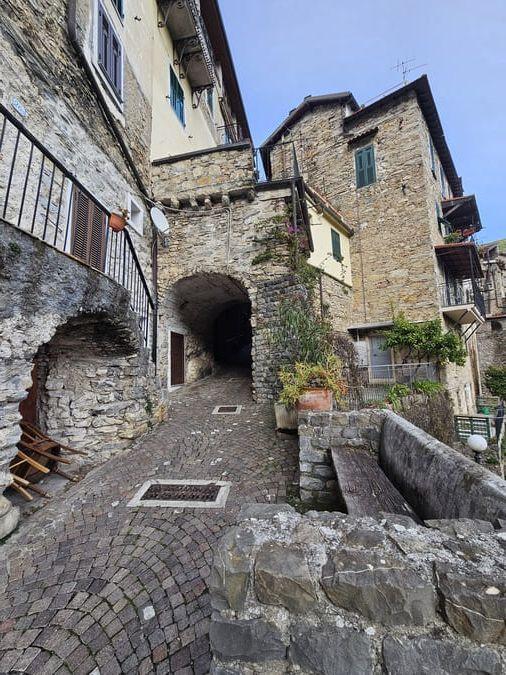
The atmosphere is very similar to that of other towns in the Nervia Valley: nothing particularly different or unique compared to the surrounding area, but still pleasant to explore, especially for those who appreciate this kind of setting.
The alleys of Rocchetta di Rocchetta Nervina
Church of Santo Stefano Protomartire[ back to menu ]
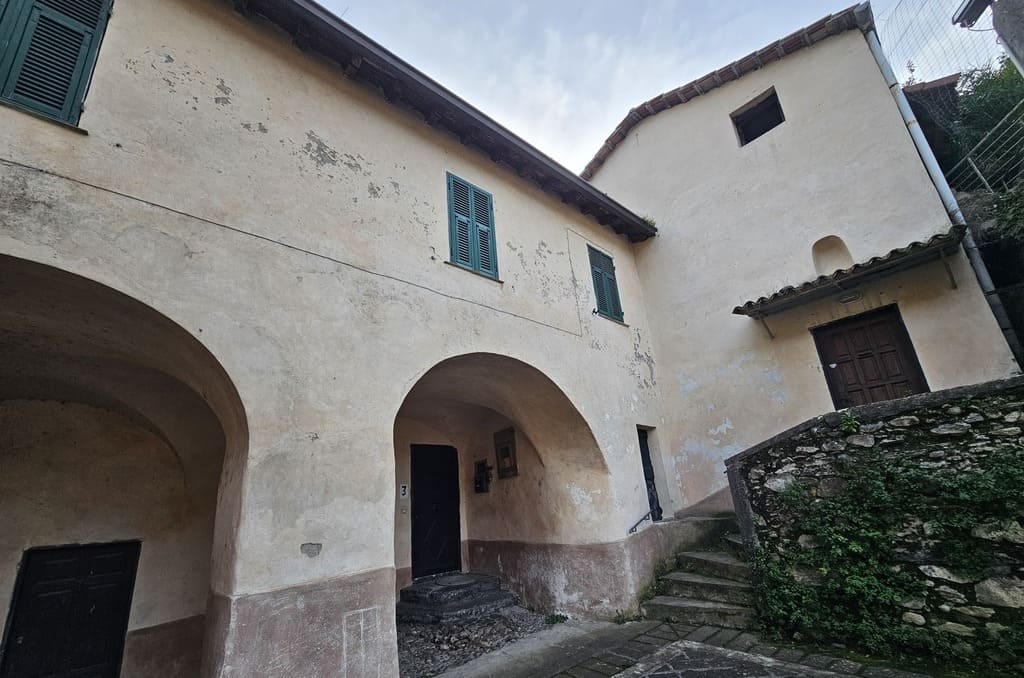
Continuing through the narrow streets, you arrive at the Parish Church of Saint Stephen the Protomartyr, located in one of the village’s main squares.
The church dates back to the 16th century, although its current appearance is the result of later Baroque-style renovations. The façade is simple and blends well into the village setting, while the interior features a single nave decorated with stucco work and frescoes.
Among the most important works is the polyptych dedicated to Saint Stephen, attributed to the Brea school, which depicts the patron saint flanked by other sacred figures. The side altars and decorations also reflect the Ligurian Baroque style, featuring light colors and gilded details.
The church overlooks a very characteristic square, also linked to local traditions. Here is the “balun” area, the site of the traditional ball game, and during the Christmas season, the traditional bonfire is lit, burning from the night of December 24 through January 6.
Via del Forno and the communal oven[ back to menu ]
Continuing past the church, you arrive at Via del Forno, whose name derives from the presence of the village’s old communal oven.
Today, the oven is not open to visitors, but there are plans to restore it and open it to the public in the future. It is, therefore, a place that offers a glimpse into the daily life of the village, even though it has not yet been developed as a tourist attraction.
Walk along the Barbaira stream [ back to menu ]
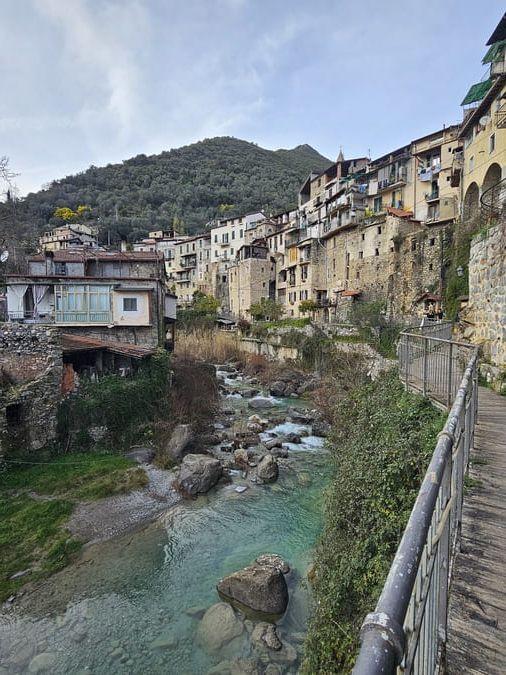
Once you leave the narrow streets, one of the most enjoyable parts of the visit is the short walk along the Barbaira stream.
It is an easy, relaxing path that follows the course of the water, with several spots where you can stop and take in the scenery. Here, you can really sense the connection between the village and the stream, which has played a vital role in the daily life of the village over the years.
Along the way, you’ll also come across several informational panels that recount the history and activities related to the use of water, with directions to the main points of interest scattered along the stream.
The walk takes just a few minutes and easily connects back to the main bridge of Rocchetta Nervina, effectively completing a small loop that allows you to see both the village and the surrounding natural environment without straying too far from the center.
History and traditions: the “E Dubarie” trail [ back to menu ]
Along the path by the Barbaira stream, you’ll come across one of the most historically interesting parts of Rocchetta Nervina: the area known as “E Dubarie,” which has now been transformed into a small open-air museum.
Here, several informational panels explain how the village has, over time, harnessed the stream’s water for productive activities and daily life.
The village’s water and production system[ back to menu ]
One of the main signs, titled “The Story of an Environmental Resource,” lists the key points related to water use along the Barbaira stream.
These include:
- flour mills
- olive presses
- tanneries
- public wash houses
- water transport channels
- facilities for hemp processing
- a hydroelectric power plant
The entire system was organized to harness the energy of the water progressively along the stream’s course, creating a true production network spread throughout the village.
E Dubarie: origin of the name and meaning[ back to menu ]
The name “E Dubarie” has several interpretations linked to the local dialect. Some connect it to the word “duba” (skin), others to the verb “dubà” (to pound), in reference to tanning activities or hemp processing.
Over time, however, the area took on a different connotation.
Being located in the lower part of the town, near the stream, it was long considered an unhealthy area.
One of the key factors in understanding its evolution is the lack of a municipal sewer system, which was not installed until 1948.
Before then, waste was managed very differently than it is today, contributing to the area’s negative reputation.
Several factors—including its location, the presence of drainage channels, and certain similarities with other towns—have led to the name “E Dubarie” also being interpreted as “the barrel district.”
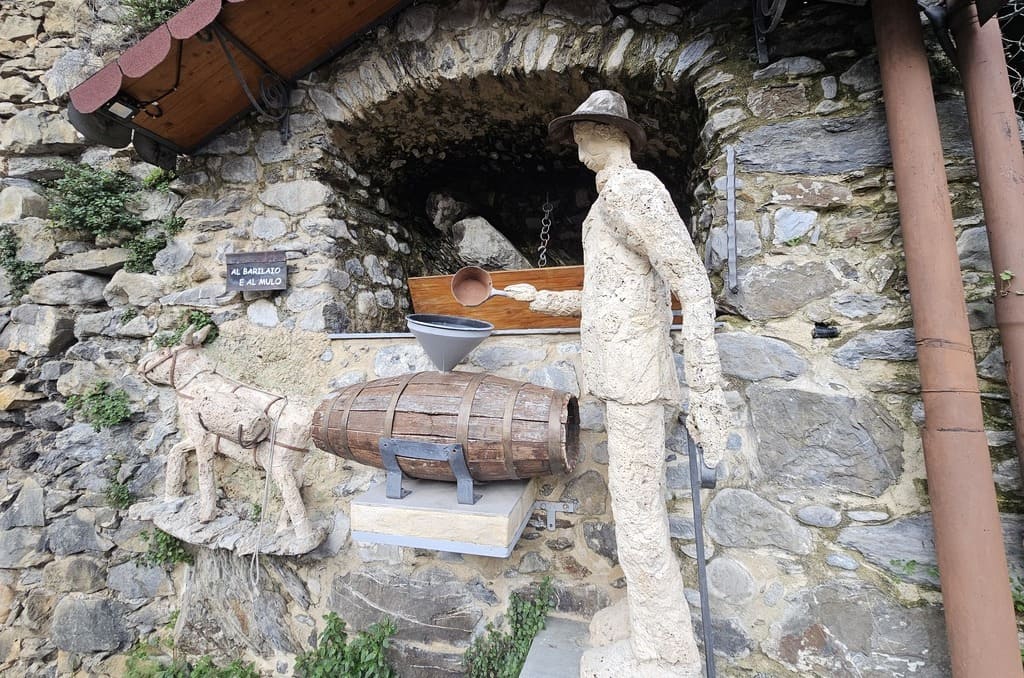
The statue of the Barilaio[ back to menu ]
A little further on, you’ll come across a statue dedicated to the Barilaio and his mule, which vividly depicts an aspect of daily life in the past.
Before the sewer system was built, it was customary to collect household waste in containers (known as “segliun”) and empty them into cesspools located outside the homes.
This is where the Barilaio came in; his job was to collect the contents into barrels and transport them—often with the help of a mule—to vegetable gardens or the countryside, where they were reused as natural fertilizer.
The statue depicts this very practice, now a distant memory but an integral part of the village’s history, and helps us better understand how resource management worked in a rural setting like that of Rocchetta Nervina.
The mills and hemp processing [ back to menu ]
Along the path by the Barbaira stream, you’ll also come across traces of the village’s historic industries, particularly the mills and facilities used for processing hemp. These features are less obvious than the ponds, but they help shed light on what daily life was like in Rocchetta Nervina.
The ritrecine millstone and the mill system[ back to menu ]
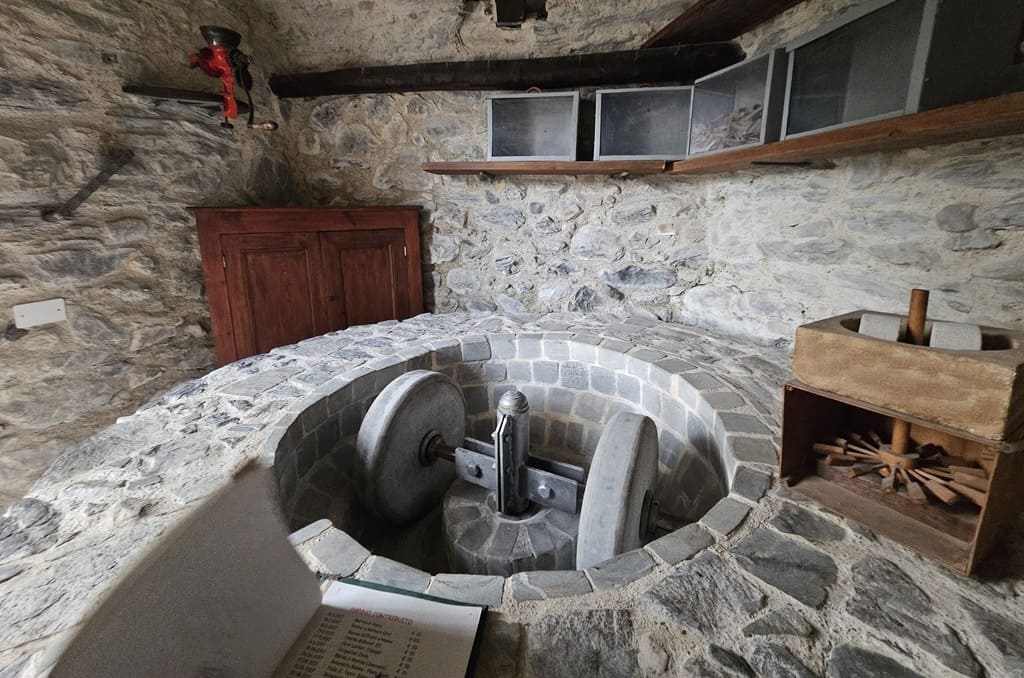
One of the most interesting features is the “ritrecine” millstone, typical of the horizontal-wheel mills common in Ligurian villages.
The mechanism was quite simple: the force of the water from the Barbaira stream was channeled through canals and used to turn a horizontal wheel positioned beneath the millstone. This generated the motion that drove the millstones.
This system was not isolated but was part of a larger network.The water was harnessed in sequence to power various activities:
- flour mills
- olive presses
- facilities for processing hemp
It was therefore an organized and sustainable system that allowed the village to be largely self-sufficient in terms of production.
The hemp press: how it worked[ back to menu ]
Hemp processing played an important role in the local economy, especially until the advent of synthetic materials. It was a fiber used to make fabrics and ropes, which were indispensable for many daily activities.
The process was complex and took place in several stages, concentrated mainly in the second half of autumn.
After maceration and the initial processing of the stalks, the hemp was processed in the so-called “pesta.”
Inside the structure, a stone millstone, powered by a hydraulic system, crushed and processed the fibers within a circular vat. This allowed the fiber to be separated from the resin, making it usable.
The buildings were very simple: often built with local stone, unplastered, with roofs supported by wooden beams. In some cases, they were open structures, designed to disperse the dust produced during processing.
From a social perspective, it was an activity that involved the entire family.
The most strenuous and continuous tasks were performed even by the youngest members, while a more experienced figure supervised the process.
The hemp mill thus represents a concrete example of how, in a context such as that of Rocchetta Nervina, natural resources were exploited directly, using simple yet effective technologies.
Listen to all podcasts published on our official channels: