News
Sustainable farmhouse in Diano Marina: green energy at the service of guests
February 05, 2026
In recent years, there has been a lot of talk about sustainability in tourism, but for us it has never been a word to use only to describe an atmosphere or an idea of hospitality. That's why we decided to become a truly sustainable farmhouse in Diano Marina, starting with what matters most: the energy we use every day.
We have chosen to invest in renewable energy, installing a photovoltaic system with storage batteries and also introducing a charging station for electric cars. Not to follow a trend, but because we believe that sustainable tourism must translate into concrete choices, capable of reducing consumption and at the same time improving the experience of those who stay here on the Ligurian Riviera.
In this article, we explain what we have done, how it works, and, above all, what changes for our guests: because an eco-friendly farmhouse should not only be more respectful of the environment, but also more consistent, transparent, and comfortable to live in.
- Why we chose to become a green farmhouse
- Our photovoltaic system: renewable energy produced directly on the farm
- Storage batteries: energy is not wasted (and we are not dependent on the grid)
- Electric car charging at Agriturismo Le Girandole: how the service works for guests
- How much we have reduced consumption - Real data
- What changes in practical terms for those staying with us
- A concrete step towards sustainable tourism on the Ligurian Riviera
Why we chose to become a green farmhouse [ back to menu ]
Those who come to a farmhouse often seek tranquility, nature, and a simpler pace of life. But in recent years, we have realized that for many people, this is no longer enough: there is growing awareness of the environmental impact of travel, and it is becoming increasingly natural to ask how much energy an accommodation facility consumes, where it comes from, and how sustainable the stay really is.
This is where our reflection began. We didn't want to limit ourselves to small measures or generic messages about sustainability: to truly be a green farmhouse, we needed a concrete change, which you can now experience by choosing to stay at our eco-friendly farmhouse in Diano Marina. Energy is one of the most important items for any tourist facility and, at the same time, one of the most invisible for guests. That's why we decided to take action where the impact is real.
The decision to produce renewable energy also stems from a specific idea of hospitality. For us, being a sustainable farmhouse does not mean asking guests to make sacrifices, but offering the same comfort while reducing waste and emissions. Less dependence on the electricity grid, greater energy autonomy, and services designed for today's travelers, such as the possibility of recharging an electric car during their stay.
It was a significant investment, but one that is consistent with how we imagine the future of tourism on the Ligurian Riviera: fewer statements, more concrete solutions.
Our photovoltaic system: renewable energy produced directly on the farm [ back to menu ]
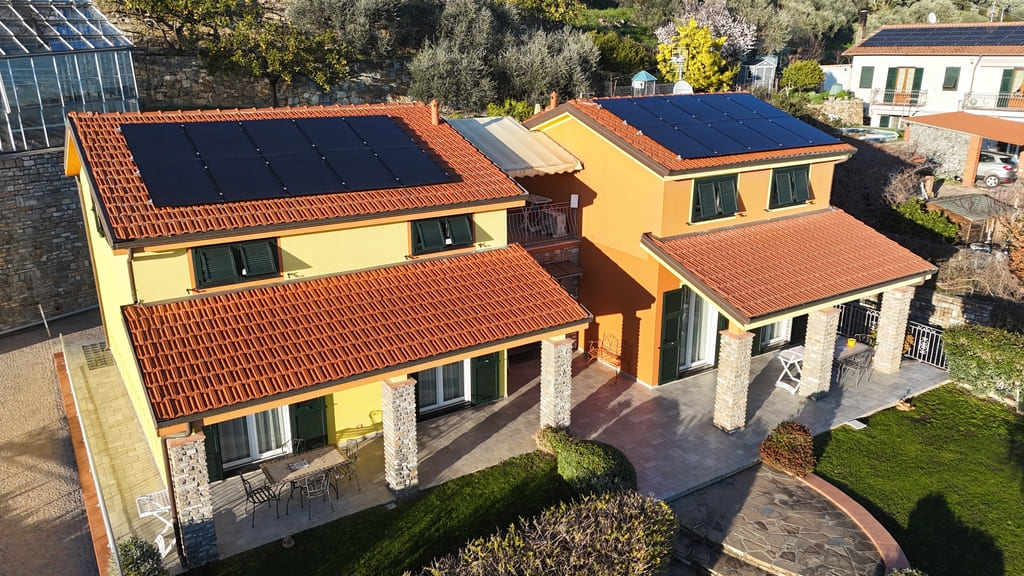
The heart of our sustainable farmhouse project is the direct production of renewable energy. We have chosen to focus on what really affects daily consumption, installing a system sized for the actual operation of the facility throughout the year. This is not a symbolic addition, but a system designed to cover most of the farmhouse's energy needs.
Power, modules, and technology installed [ back to menu ]
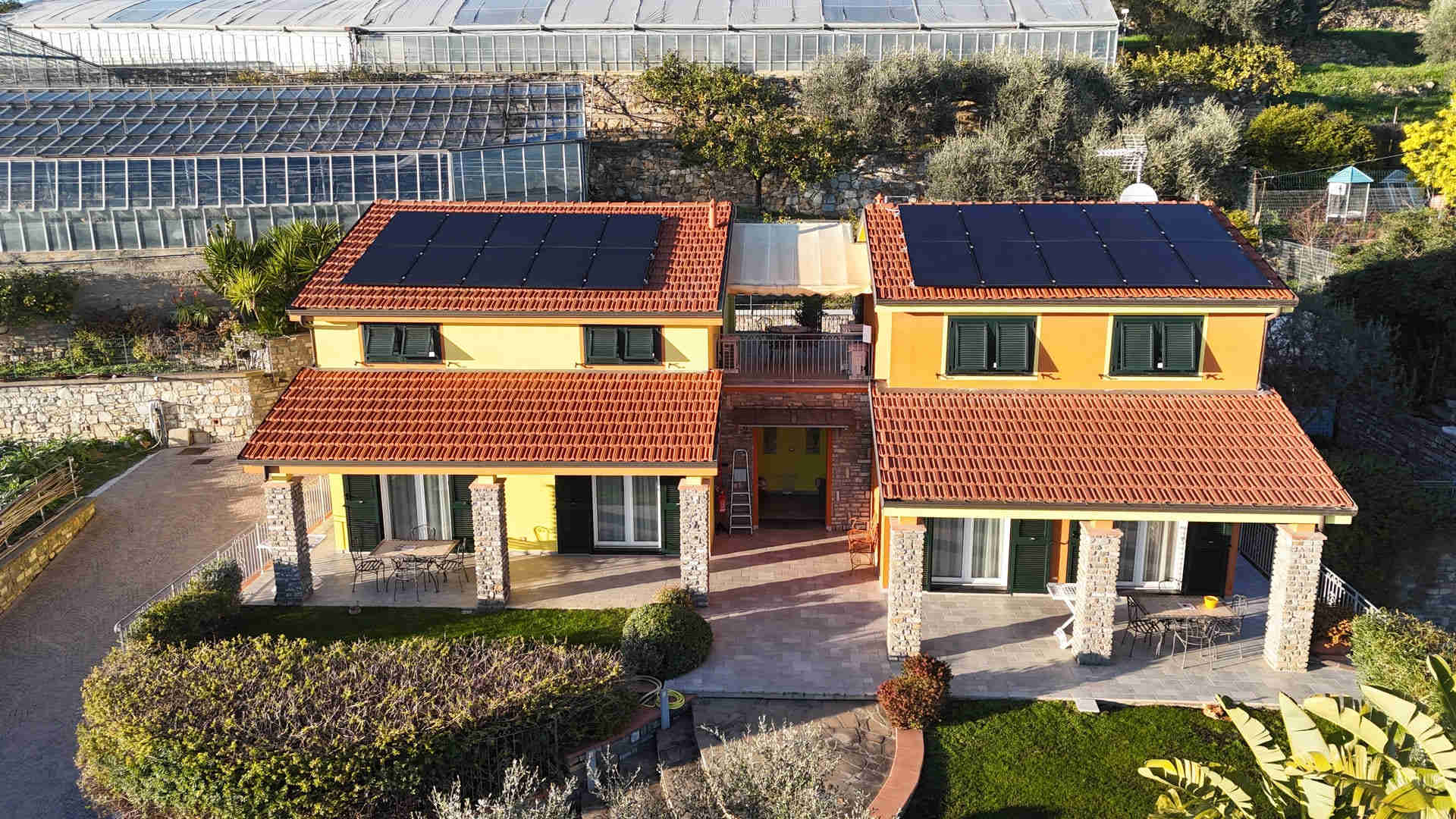
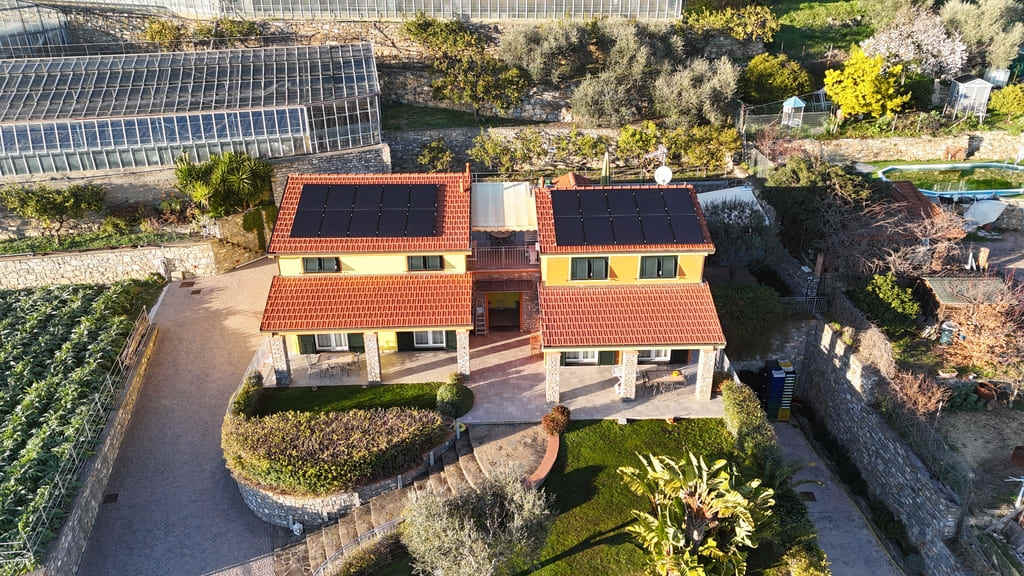
To significantly reduce the amount of energy drawn from the grid, we have installed an 8.2 kWp photovoltaic system, distributed across the two roofs of the farmhouse cottages. The system consists of 20 Canadian Solar/JA Solar photovoltaic modules and is managed by an 8 kW three-phase hybrid inverter (FOXESS/ZUCCHETTI), designed to work in an integrated manner with the facility's energy system.
The three-phase configuration allows for more balanced management of the farmhouse's daily consumption, making it possible to directly use the energy produced during the day and significantly reduce reliance on the electricity grid.
How it works during the year between winter and summer [ back to menu ]
During the year, production naturally varies according to the seasons. In the spring and summer months, the plant generates more energy than is needed to run the facility: the excess energy is then fed into the national grid.
During the rest of the year, production continues to cover a significant portion of consumption, helping to reduce the farmhouse's overall energy requirements by about two-thirds. This allows us to increase the facility's energy independence and use renewable energy for most of our daily activities.
Our photovoltaic system
Storage batteries: energy is not wasted (and we are not dependent on the grid) [ back to menu ]
Alongside the photovoltaic system, we have also installed an energy storage system, which is essential for making the most of the energy produced during the day. Without storage, a significant part would only be used during sunny hours, while in the evening the structure would return to depending almost entirely on the electricity grid. The goal, however, is to use as much energy as possible produced directly on the farm, even when there is no immediate production.
What is an energy storage system?
The system is combined with storage batteries for a total capacity of approximately 10 kWh, consisting of five three-phase modules and managed by the same three-phase hybrid inverter as the photovoltaic system.
The system stores excess energy produced during the day to make it available when needed, allowing for maximum self-consumption and further reducing energy withdrawal from the grid.
Energy autonomy and consumption stability
Thanks to the batteries, the energy produced is not only used immediately but also remains available in the evening hours or at times of peak demand. This helps to increase the energy autonomy of the facility and make consumption management more stable. The integration of photovoltaics and storage therefore allows for the continuous use of renewable energy, reducing dependence on the electricity grid and improving the overall efficiency of the system.
Electric car charging at Agriturismo Le Girandole: how the service works for guests [ back to menu ]
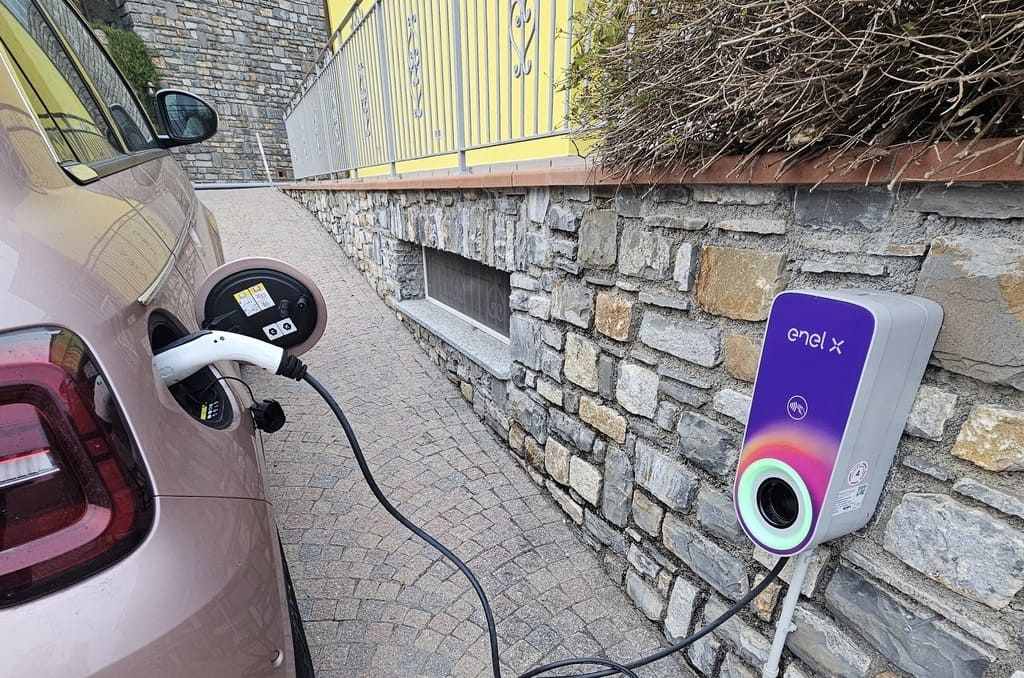
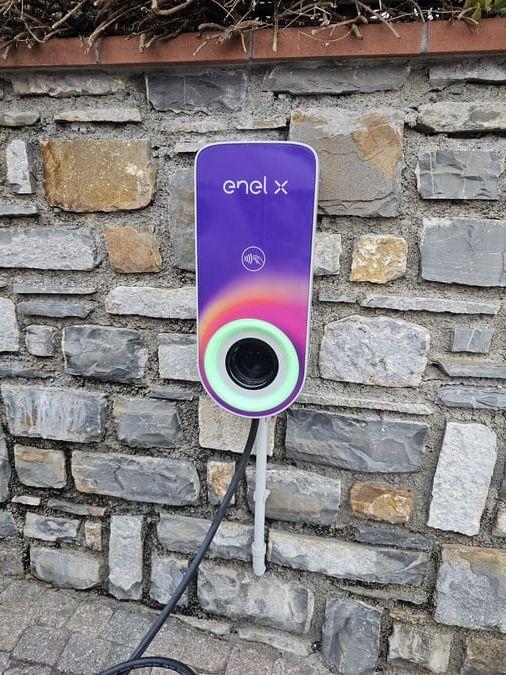
Among the services introduced with the new energy system, we have also chosen to install a charging station for electric vehicles, designed for guests staying at the farmhouse who want to recharge their cars in a simple and practical way. It is a small but useful solution: it allows you to manage charging directly during your stay, without having to travel or search for public charging points nearby.
The charging station and management via Enel On Your Way [ back to menu ]
The station has a nominal power of 7.4 kW and an effective charging power of 5.54 kW. The service is managed via the Enel On Your Way app, which automatically detects the supply of energy when it is used.
The app allows you to accurately monitor the kWh charged to the vehicle and records the date, duration, and time of charging, ensuring clear and immediate management for both the facility and the guest.
Costs, transparency, and consumption monitoring [ back to menu ]
The service is subject to a charge of €0.50/kWh. The management system allows consumption to be tracked accurately, ensuring transparency and control: each charge is associated with actual usage data, without estimates or approximations. This means that users of the charging station only pay for the energy they actually consume, with a service that is easy to use during their stay.
How much we have reduced consumption - Real data [ back to menu ]
One of the main objectives of the intervention was to achieve a measurable result, not just a theoretical one. After installing the photovoltaic system with storage batteries, we were able to verify the impact on the daily operation of the facility. The data show a significant reduction in energy consumption from the grid and a much greater use of renewable energy produced directly on the farm.
Energy produced and self-consumed [ back to menu ]
Thanks to the integrated photovoltaic and storage system, we have managed to reduce electricity consumption from the grid by about two-thirds. A significant part of the energy required by the facility is therefore produced and used directly on site. This allows us to cover most of the farmhouse's daily activities with renewable energy, increasing overall energy autonomy.
Energy fed into the national grid [ back to menu ]
During spring and summer, production exceeds the farm's needs. During these periods, the excess energy is not wasted but fed into the national electricity grid. In this way, the system continues to be useful even beyond internal consumption, contributing to the overall production of renewable energy.
Reduction of CO₂ emissions [ back to menu ]
The direct use of renewable energy leads to a concrete reduction in CO₂ emissions linked to the farm's energy consumption. The combination of autonomous production, storage, and reduced dependence on the electricity grid therefore reduces the overall environmental impact of the farm.
What changes in practical terms for those staying with us [ back to menu ]
All this is not only designed to improve consumption figures, but above all to enhance the experience of those staying at the farmhouse. Sustainability only makes sense when it becomes something that can be perceived in everyday life, without complications and without sacrifices. The aim is to offer consistent hospitality: the same comforts, greater attention to the environment, and useful services during your stay.
Energy comfort and quality of stay [ back to menu ]
Producing and using renewable energy directly means making the facility's operation more stable throughout the day. The energy used for farmhouse services comes largely from the on-site system, reducing dependence on the electricity grid. For guests, this simply translates into a regular stay, with services always available and the possibility of recharging electric cars directly on site.
More consistent and sustainable prices over time [ back to menu ]
Significantly reducing energy consumption from the grid allows for the containment of one of the main cost items for an accommodation facility. This helps to maintain more consistent rates over time in relation to actual energy consumption. This is not a theoretical promise, but a more stable balance between facility management and energy-related costs.
A more conscious stay without compromises [ back to menu ]
Choosing a sustainable farmhouse does not mean changing habits or adapting to reduced services. The idea is the opposite: maintaining the same level of comfort while reducing the overall environmental impact. Guests can therefore enjoy their vacation with greater attention to sustainability, without changing the way they travel.
A concrete step towards sustainable tourism on the Ligurian Riviera [ back to menu ]
For us, this initiative represents a clear direction rather than a goal. Integrating a photovoltaic system, storage batteries, and charging for electric cars means bringing sustainability into the daily management of the facility, not just leaving it as an intention.
We believe that sustainable tourism on the Ligurian Riviera also involves practical choices such as these: reducing consumption, increasing energy autonomy, and offering services consistent with the way more and more people travel today. The goal is not to change the vacation experience, but to make it more conscious while maintaining comfort and simplicity.
It is an important investment, made with the long term in mind: for the area, for those who stay here, and for the way we imagine hospitality in the years to come.
Listen to all podcasts published on our official channels: